Additive manufacturing of smart structures for nano-mechanical energy harvesting: A review
Reza Shamim
Hubei University of Technology, Wuhan 430068, China
A R T I C L E I N F O
Keywords:
3D printing
Energy harvesting smart structures
Sustainable energy
Nanomechanical systems
Renewable energy
A B S T R A C T
The rapid growth of compact microelectronic systems, such as wearable devices and smart sensors, has heightened the need for sustainable energy solutions to address their environmental and economic impacts. Additive manufacturing has emerged as a transformative technology in developing nano mechanical energy harvesting systems, enabling the creation of complex, customizable, and eco-friendly devices that harness ambient energy sources like vibrations, wind, solar, and biomechanical motion. This manuscript explores Additive manufacturing’s role in advancing nano-mechanical energy harvesting through innovative designs, material optimization, and integration of conversion mechanisms such as piezoelectric, triboelectric, electromagnetic, and thermoelectric processes. Key advancements include biomimetic structures, nanostructured surfaces, and topology-optimized components that enhance energy conversion efficiency, with examples like 3D printed triboelectric nanogenerators achieving power densities up to 2850 mW/m² and piezoelectric composites yielding 7.1 μW/cm². Despite progress, challenges persist, including material limitations, surface optimization, and scalable production. A bibliometric analysis (2020–July 2025) highlights research trends, with piezoelectric and triboelectric systems dominating due to their applications in IoT, wearables, and structural monitoring. Future directions involve AI-driven design, high-resolution 3d printing techniques, and advanced materials like biocompatible polymers and high-Seebeck thermoelectric composites to improve durability and efficiency. This work underscores this potential to drive sustainable, self-powered technologies, aligning with global sustainability goals.
1. Overview of smart structures and energy harvesting
The rapid proliferation of compact and multifunctional microelectronic systems, such as wearable devices and smart sensors, has intensified the demand for sustainable energy solutions. As these technologies become integral to healthcare, consumer electronics, and infrastructure monitoring, their cumulative environmental footprint grows signifi cantly [1–3]. Even modest efficiency improvements, when scaled across billions of devices, yield substantial environmental and economic benefits, including reduced greenhouse gas emissions and decreased reliance on centralized energy sources [4]. These advancements align with the United Nations’ Sustainable Development Goal 7 (SDG 7), which aims to ensure access to affordable, reliable, and modern energy by 2030 [5–7]. Achieving these sustainability objectives requires innovative strategies for energy use and localized renewable energy production, with ambient energy harvesting presenting a viable method for energizing decentralized, low-energy devices.
Additive manufacturing (AM) is thereby a major enabler in realizing sustainable energy systems. With high precision in material deposition and the possibility of achieving complex geometries with low waste, AM enables the fabrication of highly functional devices with minimal environmental impact [8–11]. Most importantly, AM enables the collaborative optimization and fabrication of mechanical components and energy-harvesting elements in unison, which is a progressive step toward directly embedding energy-harvesting functionality in device components with strategic importance. Leveraging on the flexibility offered by AM, there have been significant developments in mechanical energy harvesting systems, and their applications have been extended to various fields with different focus areas as well. These systems, which work on exploiting ambient sources of energy, have been increasingly finding applications in areas like biomedical sensor applications, structural health control, and smart infrastructure systems, ensuring sustainable, independent, and almost negligible-energy-input services with remarkable autonomy and reliability in their overall performance analysis [12].
Unlike traditional batteries, which suffer from low energy density, short lifespans, and high disposal costs [13], ambient sources such as wind [14], ocean waves [15], solar [16], raindrops [17], body movement [18], heat [19], sound [20], vibrations [21], geothermal gradients [22], and temperature fluctuations [23] provide renewable alternatives. These inputs are converted into usable energy through mechanisms like electromagnetic, piezoelectric, triboelectric, and thermoelectric processes, each offering distinct advantages for low-power applications.
AM’s capacity for structural innovation further enhances the performance of energy harvesting systems. For instance, Yin et al. [24] employed iso-geometric optimization on 3D printed Mindlin plate structures to widen phononic band gaps, achieving a central gap of 731.25 Hz. Similarly, Lowell’s holographic fabrication of 3D photonic crystals introduced a novel approach to elastic wave energy harvesting [25].
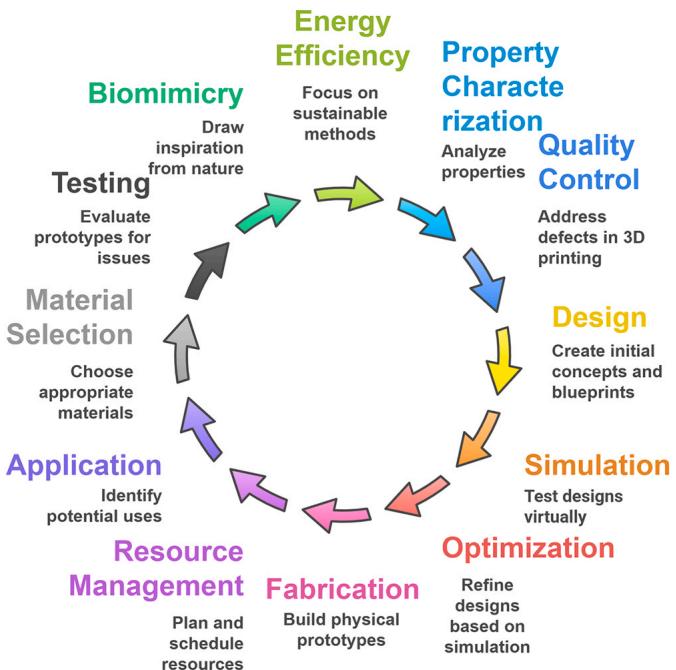
Energy harvesting technologies exploit diverse ambient energy sources, including vibrations, biomechanical motion, rainfall, wind, solar, and ocean energy, to convert environmental energy into usable power [26]. These technologies support a wide range of applications, such as alcohol sensing, weather monitoring, pacemakers, wearable health devices, structural health monitoring, wastewater treatment, navigation systems, and dedicated energy harvesting platforms, highlighting their broad industrial relevance. As illustrated in Fig. 1, their advancement relies on key enabling factors, including simulation and experimental validation, biomimetic design approaches, material optimization, defect and mechanical property analysis, and energy efficiency enhancement, reflecting the inherently multidisciplinary nature of this field.
This review focuses on the transformative role of AM in developing smart structures for nano-mechanical energy harvesting (NMEH) systems, specifically targeting ambient mechanical and hybrid energy sources (e.g., vibrations, wind, and biomechanical motion) converted via piezoelectric, triboelectric, electromagnetic, and hybrid mechanisms. Drawing primarily on literature from 2020 to 2025 (as evidenced by our bibliometric analysis in Section 2), we emphasize AM-enabled innovations in design flexibility, material optimization, and integration for sustainable applications in IoT, wearables, and structural monitoring. Standalone non-mechanical harvesting (e.g., pure photovoltaic or biochemical) is excluded unless synergistically combined with mechanical components, ensuring a focused examination of AM’s
flowchart
graph TD
    A["Biomimicry"] --> B["Testing"]
    B --> C["Material Selection"]
    C --> D["Application"]
    D --> E["Resource Management"]
    E --> F["Fabrication"]
    F --> G["Optimization"]
    G --> H["Simulation"]
    H --> I["Quality Control"]
    I --> J["Property Characterization"]
    J --> K["Energy Efficiency"]
    K --> L["Build physical prototypes"]
    L --> M["Refine designs based on simulation"]
    M --> N["Design"]
    N --> O["Test designs virtually"]
    O --> P["Address defects in 3D printing"]
    P --> Q["Analyze properties"]
    Q --> R["Focus on sustainable methods"]
    R --> S["Draw inspiration from nature"]
    S --> T["Biomimicry"]
    T --> U["Evaluate prototypes for issues"]
    U --> V["Choose appropriate materials"]
    V --> W["Identify potential uses"]
    W --> X["Plan and schedule resources"]
Fig. 1. Key multidisciplinary elements driving progress in nano-mechanical energy harvesting.
structural contributions to efficiency and scalability.
Despite these advances, several challenges impede the widespread adoption of AM-enabled energy harvesting systems. Key issues include:
− Surface Optimization: Encounters challenges in developing integrated surface structures that efficiently accommodate multiple harvesting mechanisms (e.g., triboelectric, piezoelectric), as diverse material and geometric requirements complicate achieving a single, high-performing surface structure [27,28].
− Material Limitations: Faces significant challenges from the limited availability of biocompatible and long-lasting polymers for 3D printing, which hinders the creation of implantable or wearable devices that necessitate long-term stability and safety in medical devices [29].
− Electromagnetic Integration: Is limited by the difficulty in utilizing AM resolution to achieve small, high-accuracy coils and magnets, which are necessary to miniaturize devices without compromising efficient energy conversion and integration in small-scale systems [30].
High-Temperature Requirements: Confronts challenges in developing high-performance rare-earth ceramics, as the hightemperature processes involved are difficult to control and scale, impacting the manufacturing of durable, efficient thermoelectric modules for practical applications [31].
− Frictional Wear: It suffers from problems of wear and degradation in phase-change materials, which are essential for energy absorption and support sustained energy release; therefore, more robust materials need to be developed to increase the working lifetime under repeated thermal cycling. [32].
In this review, AM is examined for the role it plays in the integration of materials and geometries in the production of NMEH structures. It will assess the advantages and limitations of using energy conversion mechanisms based on AM technology, including piezoelectric, triboelectric, electromagnetic, and combination mechanisms. Additionally, the key scalability problems faced in the field will be discussed with proposed directions for the future, such as design using artificial intelligence (AI).
1.1. Role of AM in advancing energy harvesting
By using 3D printing, manufacturers can create functionally integrated, geometrically complex components that improve energy conversion and integration. Some prominent examples of AM applications in energy harvesting are biomimetic solar concentrators based on natural tree structures [33], nanostructured surfaces designed for improved triboelectric output [34], aerodynamically optimized turbine blade casings for wind energy conversion [35], and bespoke substrates for embedding piezoelectric materials with high surface contact [36]. These AM-based developments provide precise control of both form and function, catering to the degree of customization necessary for the optimization of energy harvesting device performance.
Energy harvesting technologies are being extensively utilized in healthcare for wearable biosensors, in structural health monitoring for wireless diagnostic sensors, in environmental sensing for remote monitoring networks, and sustainable energy systems for low-power applications such as LED lighting and micro-power water treatment. These devices are self-sustaining, scalable, lightweight, and maintenance-free [37]. These applications take advantage of the self-sufficiency, scalability, and lightweight characteristics of energy harvesting devices, which typically involve little maintenance. A NMEH system functions through four modules: 1) Energy Sources (vibrations, wind, solar, waves, motion, precipitation); 2) Conversion Mechanisms (piezoelectric, triboelectric, electromagnetic, electrostatic); 3) Post-Processing/Storage (rectified, stored in supercapacitors/micro-batteries); and 4) Application-Specific Design (optimized for efficiency, adaptability, durability), facilitating lightweight, scalable, low-maintenance devices for healthcare, structural monitoring, environmental sensing, and sustainable energy [38–41]
2. Bibliometric analysis of 3D printing in energy research
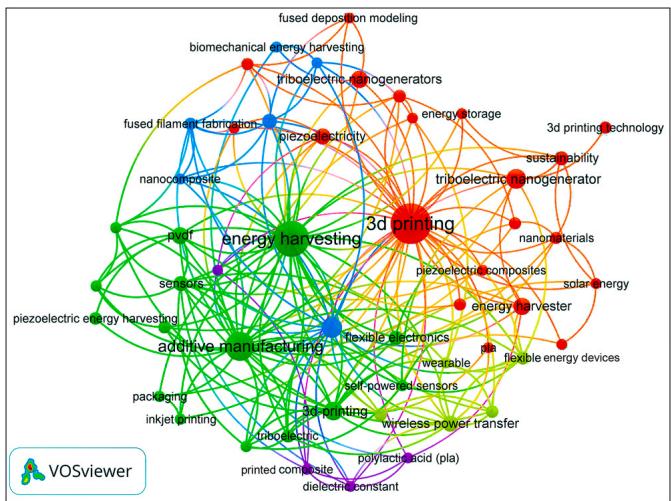
A bibliometric and keyword-based trend analysis was performed to provide a quantitative overview of research activity related to AM–enabled energy harvesting. The Scopus database was selected due to its broad coverage of peer-reviewed journals in engineering and applied sciences. The analysis covered publications from January 2020–2025. The search strategy combined terms associated with additive manufacturing (e.g., 3D printing, additive manufacturing, fused deposition modeling, inkjet printing) and energy harvesting technologies (e. g., piezoelectric, triboelectric, thermoelectric, photovoltaic, electromagnetic, acoustic, and biochemical energy harvesting). Only Englishlanguage journal articles were considered, while conference papers, editorials, and non-research documents were excluded to ensure consistency and reproducibility. The bibliometric assessment focused on three primary indicators: (i) distribution of publications across different energy harvesting mechanisms, (ii) keyword co-occurrence analysis to identify dominant research themes and their interconnections, and (iii) institutional productivity based on author affiliations. These indicators are commonly adopted in bibliometric studies to reveal research trends and thematic evolution.
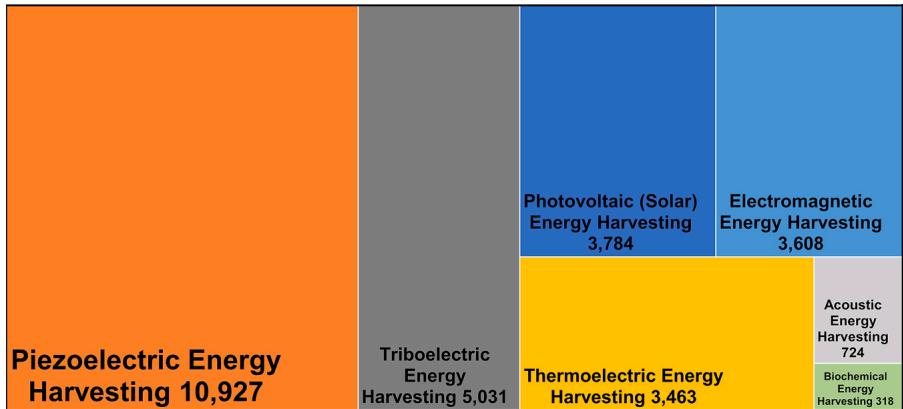
Fig. 2 presents the distribution of publications according to energy harvesting mechanisms, including piezoelectric, triboelectric, thermoelectric, photovoltaic, electromagnetic, acoustic, and biochemical energy harvesting. The results indicate a pronounced concentration of publications in piezoelectric and triboelectric energy harvesting, reflecting their strong compatibility with AM processes, material versatility, and suitability for miniaturized and flexible devices. In contrast, comparatively fewer studies focus on biochemical and acoustic energy harvesting, suggesting that these areas remain less explored within the context of AM during the investigated timeframe.
To further explore thematic relationships, a keyword co-occurrence analysis was conducted using VOSviewer. Fundamental search terms such as “3D printing,” “additive manufacturing,” and “energy harvesting” were excluded to better capture associated concepts and application-driven research directions. The resulting network visualization (Fig. 3) reveals several interconnected thematic clusters. Frequently occurring keywords include piezoelectric, triboelectric nanogenerator, nanomaterials, polyvinylidene fluoride (PVDF), flexible electronics, printed composites, inkjet printing, piezoelectric composites, wearable electronics, solar energy, and sustainability. The strong co-occurrence links between materials (e.g., PVDF and nanomaterials), enabling technologies (e.g., printed and flexible electronics), and application domains highlight the multidisciplinary nature of AM-based energy harvesting research.
flowchart
graph TD
    A["3d printing"] --> B["energy harvesting"]
    A --> C["adhesive manufacturing"]
    A --> D["fused deposition modeling"]
    A --> E["biomechanical energy harvesting"]
    A --> F["triboelectric nanogenerators"]
    A --> G["piezoelectricity"]
    A --> H["energy storage"]
    A --> I["3d printing technology"]
    A --> J["sustainability"]
    A --> K["nanomaterials"]
    A --> L["solar energy"]
    A --> M["energy harvester"]
    A --> N["flexible energy devices"]
    A --> O[" flexible electronics"]
    A --> P["weavable"]
    A --> Q["self-powered sensors"]
    A --> R["wireless power transfer"]
    A --> S["polyacetic acid (pla)"]
    A --> T["dielectric constant"]
    A --> U["paplogly"]
    A --> V["inkjet printing"]
    A --> W["packaging"]
    A --> X["inkjet printing"]
    A --> Y["rapoelastic"]
    A --> Z["printed composite"]
    A --> AA["dielectric constant"]
Fig. 3. Network of key terms in 3d printing and energy harvesting (VOSviewer).
In addition to thematic trends, institutional productivity was examined based on publication affiliations (Fig. 4). The analysis identifies leading research institutions actively contributing to this field, including the University of Chinese Academy of Sciences, National University of Singapore, Tampere University, University of Manchester, Peking University, Purdue University, Deakin University, and Qingdao University. This distribution reflects the global engagement in AM-enabled energy harvesting research and indicates the presence of established research hubs driving advances in materials, device design, and application development.
3. AM enabled energy harvesting technologies
3.1. Electrostatic energy harvesting and AM enhanced performance
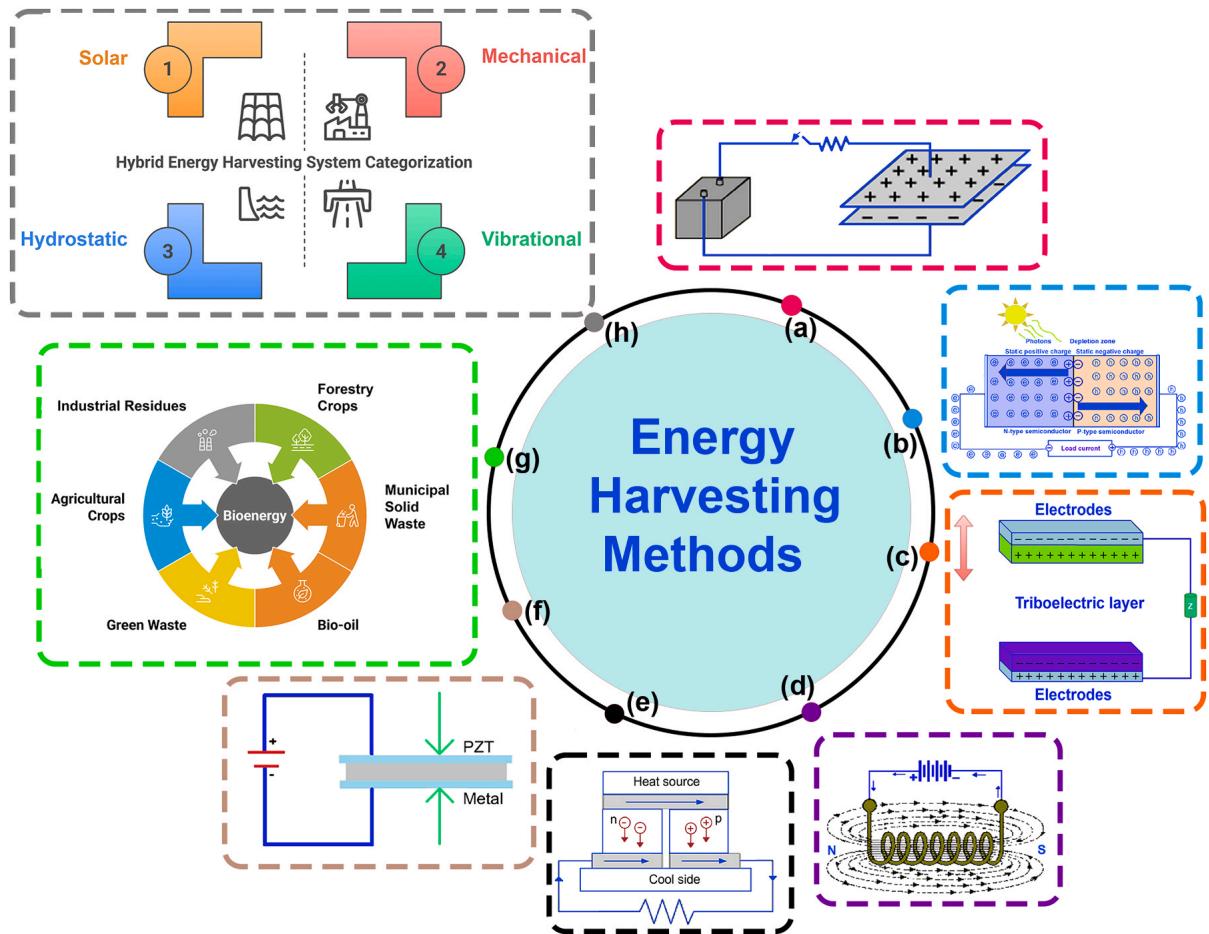
Electrostatic energy harvesting produces electricity from the relative movement of charged surfaces or electrodes, employing capacitive variations to transform mechanical energy into electrical energy. It is well-suited for low-frequency vibrations and small applications like wearable systems and wireless sensors (Fig. 5a). AM has improved electrostatic energy harvesting through accurate electrode configurations and miniaturized structures. Zhang et al. [42] employed nano-graphite-coated paper as an eco-friendly high-performance material for TENGs, facilitating energy harvesting and motion sensing with greater than 14 kW m⁻² power density. Further, Li et al. [43] created vibration energy harvesting technologies (triboelectric, piezoelectric, electromagnetic) for self-powered IoT, promoting smart monitoring,
treemap
| Category | Value |
|---|---|
| Piezoelectric Energy Harvesting | 10,927 |
| Triboelectric Energy Harvesting | 5,031 |
| Photovoltaic (Solar) Energy Harvesting | 3,784 |
| Electromagnetic Energy Harvesting | 3,608 |
| Thermoelectric Energy Harvesting | 3,463 |
| Acoustic Energy Harvesting | 724 |
| Biochemical Energy Harvesting | 318 |
Fig. 2. Distribution of energy harvesting types in Scopus (2020–2025).

text_image
institute of nanoscience and nanotechnology (inn), national centre for scientific research “demokrit department of chemical engineering and analytical science, the university of manchester, manchester, college of materials science and engineering, qingdao university, qingdao, 266071, china marine college, shandong university, weihai, 264209, china school of engineering, deakin university, geelong, 3216, vic, australia department of electrical and computer engineering, national university of singapore, singapore, 1176 academy of scientific and innovative research (acsir), ghaziabad, 201002, india department of robotics and mechatronics engineering, daegu gyeongbuk institute of science and techn electrical engineering college, northwest minzu university, gansu, china school of nanoscience and technology, university of chinese academy of science, Beijing, china augmentative technology group, tampere university, korkeakoulunkatu 3, tampere, finland school of electrical and computer engineering, georgia institute of technology, 85 5th st nw, atlant state key laboratory of polymer materials engineering, polymer research institute of sichuan univers department of electrical and computer engineering, national university of singapore, 4 engineering d department of flexible and printable electronics, lanl-jbnu engineering institute, jeonbuk national university of chinese academy of sciences, beijing, 100049, china school of materials science and engineering, peking university, beijing, 100871, china school of mechanical engineering, purdue university, west lafayette, 47907, in, united states VOSviewer
Fig. 4. Research institutions in nanoscience and engineering (VOSviewer).
flowchart
graph TD
    A["Solar"] --> B["Hybrid Energy Harvesting System Categorization"]
    C["Mechanical"] --> D["Vibrational"]
    E["Hydrostatic"] --> F["Bioenergy"]
    G["Industrial Residues"] --> H["Forestry Crops"]
    I["Agricultural Crops"] --> J["Municipal Solid Waste"]
    K["Green Waste"] --> L["Bio-oil"]
    M["PZT"] --> N["Metal"]
    O["Heat source"] --> P["Cool side"]
    Q["Electrodes"] --> R["Triboelectric layer"]
    S["Hydrostatic"] --> T["Vibrational"]
    U["(a)"] --> V["(b)"]
    W["(c)"] --> X["(d)"]
    Y["(e)"] --> Z["(f)"]
    AA["(g)"] --> AB["(h)"]
Fig. 5. Classification of energy harvesting methods, including a. Electrostatic, b. Photovoltaic, c. Triboelectric, d., Electromagnetic e. Thermoelectric, Piezoelectric g. Bioenergy Sources, h. Hybrid Systems (Images are reused with the permission of the publisher).
transportation, and healthcare. Although stability and efficiency are challenging, artificial intelligence of things (AIoT) integration offers sustainable, intelligent systems for a zero-emission future.
3.2. Photovoltaic energy harvesting and AM enhanced performance
Photovoltaic energy harvesting utilizes sunlight to generate electricity through semiconductor materials that produce charge carriers upon light exposure. The method is broadly used in powering remote sensors, portable electronics, and eco-friendly infrastructure (Fig. 5b). AM has boosted photovoltaic energy harvesting through the provision of tailored solar cell geometries and integrated designs. Li et al. [44] developed strategies for environmentally friendly organic photovoltaics through green solvents, overcoming limitations such as low solubility and slow drying to enhance film morphology and efficiency. In addition, Kutsarov et al. [45] reviewed an advance in flexible perovskite solar cells, emphasizing efficiency improvement (>23 %) and scalable fabrication methods such as roll-to-roll processing. Key challenges include substrate restrictions, electrode brittleness, and ink optimization for low-temperature deposition. Breakthroughs in interfacial engineering, encapsulation, and green inks are critical to commercialization, with applications in wearables, IoT, and space photovoltaics.
3.3. Triboelectric systems and AM enhanced electrode/surface designs
Triboelectric AM integrates the process of producing electric charges via contact and subsequent separation of dissimilar materials, with AM’s precise control over surface and electrode designs for energy harvesting. Charge transfers due to friction, directed by the triboelectric series, are optimized via controlled surface chemistry and geometry, demonstrated in AM metal powders such as CpTi. Additional parameters such as particle size and humidity also affect tribo charging, with optimized efficiency demonstrated in devices such as TENGs (Fig. 5c). AM improves triboelectric systems by providing precise control over surface properties and electrode designs. For example, research on triboelectric charging in AM metal powders, i.e., CpTi, Ti6Al4V, and SS 316 L, demonstrated that surface chemistry and flow rate have a significant effect on tribocharging behavior, providing insights into optimizing triboelectric energy harvesting surfaces [46]. AM further advances triboelectric systems by enabling nanomesh structures for TENGs. For instance, an electrospun polyurethane composite nanomesh, functionalized with amino-rich graphitic carbon nitride (g-C₃N₄), creates a flexible PU-encapsulated g-C₃N₄/Ecoflex device. This device achieves a high output (465 V, 62.15 μA) and a power density of , maintaining stability over 50,000 cycles [47].
3.4. Electromagnetic SYstems and Coil/magnetic Component Fabrication
Electromagnetic energy harvesting relies on Faraday’s law of induction, where electrical current is generated by relative motion between a magnet and a coil. It is a highly effective mechanism for vibration or rotation source energy harvesting (Fig. 5d). AM-enabled electromagnetic Generator (EMG) energy harvesting by the precise manufacturing of coils and magnetic components. Son et al. [48] evaluated 3D printed energy devices, reporting that they can be utilized to create high-performance complicated structures for energy generation and storage. Although offering design flexibility and material versatility, additional problems in ink formulation and mechanical durability should be resolved for large-scale applicability. Similarly, Jalali et al. [49] fabricated 3D printed chitosan/MXene aerogels for triboelectric energy harvesting enhancement, where MXene up to 2 wt% enhances voltage to 110 V. MXenes enhance polarization and surface charge density, charge transfer efficiency, and electromagnetic energy harvesting, enabled by the accurate control of porous structures via AM.
3.5. Thermoelectric harvesting and AM enhanced module architecture
Thermoelectric harvesting has also been boosted by AM. The flexible Ag₂Se/Sb₂Te₃ modules, which were fabricated through selective laser melting and stereolithography, maintained 90 % functionality after 1000 mechanical bends while producing over near room temperature [50]. While Baroutaji et al. [51] assessed AM applications for thermoelectric materials, they quoted advantages in terms of complex geometries, material efficiency, and cost savings compared to conventional techniques. Though AM enables innovative thermoelectric device geometries with better heat-source conformity, material performance, surface finish, and anisotropic properties must be optimized for large-scale commercialization (Fig. 5e). Thermoelectric energy harvesting relies on the Seebeck effect, converting temperature gradients into electrical energy using thermoelectric materials. The mechanism is critical for waste heat recovery and remote power applications. Going a step further, Maduabuchi et al. [52] optimized a two-stage segmented thermoelectric generator (TEG) for solar conversion, achieving 62.4 % higher power output (22.43 W) and 27.5 % better efficiency through geometric parameter optimization. The system also reduced the cost by 14.6 % and CO₂ by 10.65 kg/year, showing great potential for actual renewable energy uses.
3.6. Piezoelectric systems and structural/integration benefits
Piezoelectric energy harvesting is a method of converting mechanical stress into electrical energy by the piezoelectric effect, in which certain materials generate charge when they deform (Fig. 5f). The method is particularly suitable for ambient vibration harvesting for wearable electronics and structural health monitoring. Zhou et al. [53] fabricated translucent porous PVDF composites filled with ZnO/Ag particles, which provided enhanced β-phase content output) and force sensitivity (1.155 V/kPa) by interfacial electrostatic effects. The material was demonstrated to enable self-powered tactile sensors and biomechanical energy harvesting with potential for wearable electronics and human-machine interfaces. Chen et al. [54] also gave a brief overview of flexible piezoelectric materials for integrated sensing, actuation, and energy harvesting, referencing recent polymer (e.g., PVDF), composite, and inorganic thin film developments. While these materials enable wearable applications because of conformability and multifunctionality, scalable manufacturing is impeded by difficulties in balancing performance.
3.7. Bioenergy sources and AM improved utilization
Bioenergy harvesting extracts energy from organic materials such as biomass, biofuels, and microbial fuel cells through processes like fermentation and combustion (Fig. 5g). This method is valuable for sustainable power generation in rural areas and waste management systems. Mukherjee et al. [55] demonstrated a microbial fuel cell (MFC) using a novel bacterial consortium (Kocuria rosea, Bacillus circulans, Corynebacterium vitaeruminis) for simultaneous aromatic hydrocarbon bioremediation and bioelectricity generation. The optimized system achieved 0.8 V output, 81.81 % chemical oxygen demand reduction, and 18.15 mW/m² power density using sodium benzoate, while enabling salt bridge reuse to lower costs. This highlights MFC’s potential for sustainable wastewater treatment and energy recovery. Notably, Begum et al. [56] reviewed hybrid thermochemical-biochemical biomass conversion, showing improved efficiency and cost-effectiveness for waste-to-energy systems. Integrated approaches enhance biofuel production while supporting circular economy goals, though scalability challenges remain.
3.8. Hybrid harvesting and AM driven integration
Hybrid energy harvesting combines different mechanisms for maximum energy scavenging from ambient sources of diverse nature (Fig. 5h). It enhances reliability and efficiency in dynamic conditions. AM has enabled the creation of hybrid systems for energy scavenging from low-grade thermal sources. Stirling engine-assisted modules with both triboelectric and piezoelectric components, for instance, have reported up to 74 V output while scavenging from temperatures less than 100◦C [57]. For wind energy harvesting, Ravichandran [58] developed a mini wind-powered TENG using a 3D printed venturi structure. The system achieves a record power density of 2850 mW/m² (4.5 mW peak) - outperforming larger systems - and can power 40 LEDs or charge capacitors in 20 s. A polycarbonate flag structure provides reliability through 10,000 cycles, demonstrating great potential for standalone IoT applications. While Han et al. [59] optimized a 3D printed small-scale electromagnetic wind energy harvester for air flow application, with 0.305 W output (6.59 % efficiency) for powering 4 LEDs. Parametric optimization of blade design and air flow pathways demonstrated a trade-off between self-starting capability and conversion efficiency, with potential application in HVAC and city energy harvesting.
4. Advanced structural and material innovations
4.1. Topology optimization and geometric customization enabled by AM
Various AM-enabled designs have demonstrated that performance is highly dependent on the geometric arrangement and material interface. For instance, Kim et al. [60] presented a wind-driven TENG with rolling polymer beads, producing 1.36 mW/cm² power density at 20 m/s wind speed. The device is a self-powered, omnidirectional wind sensor that powers LEDs, showing promise for portable applications, while Liu et al. [61] designed a magnetic switch-structured TENG for continuous and steady wind energy harvesting, producing 4.82 mW peak power—sufficient to illuminate 500 LEDs or operate a thermometer—by exploiting magnetic force instead of wind speed to control output. A hybrid energy module integrating contact-mode and slide-mode TENGs with solar cells was fabricated, producing up to 66.64 mW for powering small electronics and offering a sustainable approach to IoT and wearable devices [62]. A critical review of small-scale photovoltaic-thermoelectric hybrid systems was performed, comparing electrical connections, control strategies, and maximum power point tracking approaches, while emphasizing the necessity of improved electronic interfaces and system-level designs for enhancing energy harvesting efficiency for future IoT applications [63].
4.2. Functional materials and micro-/nano-structuring via AM
Chang et al. [64] fabricated a 3D printed piezoelectric polymer composite with optimized composition and auxetic geometry, resulting in a threefold increase in voltage compared to flat structures. The flexible sensor exhibited robust piezoelectric response and was suitable for self-powered tactile position sensing. Li et al. fabricated a 3D printed flexible piezoelectric composite with combined sensing and actuation capabilities, with 1830 ppm strain and 26.81 V/g sensitivity. The device actuated miniature robots and detected joint movement, with potential applications in robotics and wearables [65]. Reverse electrowetting systems have also reported high energy conversion efficiency (up to 40.2 % at 3.3 V), through advances in surface patterning and fluid interaction control [66]. AM allows for micro- and nano-scale structuring of surfaces, with increased surface area and charge generation in energy harvesters. Surface functionalization through AM optimizes material interactions, with improved device performance.
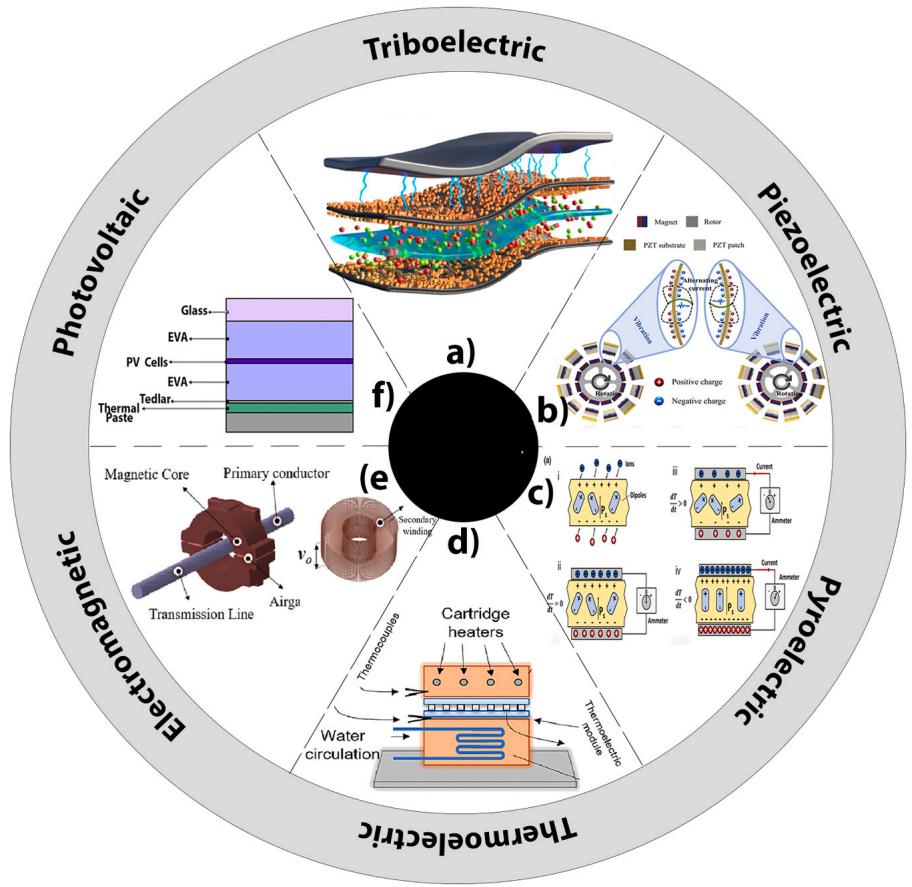
Fig. 6 offers a comprehensive schematic of various energy harvesting technologies, organized around a central hub to illustrate their interconnected potential. Fig. 6a [67] shows a self-integrated structural supercapacitor TENG device based on MoO₃ on carbon cloth for dual-mode energy storage and triboelectric harvesting with a capacitance of 97.86 and a voltage of 55 V. Fig. 6b [68] demonstrates a piezoelectric energy-harvesting shock absorber for light trucks, harnessing suspension vibration as electricity with a maximum power output of 7.51 W. Fig. 6c [69] introduces electret-based energy harvesters with their structural compliance and high-voltage output for powering small-scale systems. Fig. 6d [70] is the impedance response of thermoelectric modules with minor temperature differences, using equivalent circuits for examining thermal contact resistances and optimizing energy harvesting performance. Fig. 6e [71] presents a nonlinear electromagnetic energy harvester for vibration de-icing robots with more than 10 W output based on a nonlinear core model. Fig. 6f [72] displays the spectral division of a photovoltaic panel by a ZnO-water nanofluid filter, paraffin-ZnO thermal storage layer, and TiO2-glass coated layer with % electrical efficiency improvement (ηel) and 5.3 % CO2 reduction. The panel is composed of a 3.2 mm thick glass layer (τ = 0.91, self-cleaning coated TiO2 for case 4), ZnO-water nanofluid filter (0.02 mass fraction, cases 2–4), silicon layer (0.3 mm, optimal range 700–1100 nm), and a 10 mm RT25-ZnO paraffin layer.
flowchart
graph TD
    A["Photovoltaic"] --> B["Triboelectric"]
    B --> C["Piezoelectric"]
    C --> D["Pyroelectric"]
    D --> E["Thermoelectric"]
    E --> F["Electromagnetic"]
    F --> G["Magnetic Core"]
    G --> H["Primary conductor"]
    H --> I["Transmission Line"]
    I --> J["Airga"]
    J --> K["Secondary winding"]
    K --> L["Cartridge heaters"]
    L --> M["Water circulation"]
    M --> N["Thermoelectric module"]
    style A fill:#f9f,stroke:#333
    style B fill:#ccf,stroke:#333
    style C fill:#cfc,stroke:#333
    style D fill:#fcc,stroke:#333
    style E fill:#cff,stroke:#333
    style F fill:#ffc,stroke:#333
    style G fill:#cfc,stroke:#333
    style H fill:#cfc,stroke:#333
    style I fill:#cfc,stroke:#333
    style J fill:#cfc,stroke:#333
    style K fill:#cfc,stroke:#333
    style L fill:#cfc,stroke:#333
    style M fill:#cfc,stroke:#333
    style N fill:#cfc,stroke:#333
Fig. 6. Schematic representation of energy harvesting technologies, including a. Triboelectric, b. Piezoelectric, c. Pyroelectric, d. Thermoelectric, e. Electromagnetic, and f. Photovoltaic Methods (Images are reused with the permission of the publisher).
4.3. Emerging designs and novel AM compatible materials
A number of other innovations also enhance the functionality of AMenabled harvesting systems (Table 1). As an example, 3D printed nanogenerators based on polyvinyl alcohol / layered double hydroxides composites reached voltages of up to 60 V with a tolerance of suitable for self-powered physiological monitoring [78]. Xu et al. [79] performed dynamic analysis of floating TENGs through detailed simulations, showing how wave-induced motion and structural parameters influence energy harvesting. With 6DoF tracking and simulations, they determined optimum structures for better blue energy conversion efficiency.
5. NMEH: system architecture and integration
The demand for battery-free, miniaturized devices such as autonomous sensors and wearables has driven the adoption of NMEH technologies, which harvest ambient energy and reduce reliance on batteries [80,81]. Advances in AM and 3D printing have enabled more efficient, compact, and multifunctional NMEH systems using micro- and nano-scale transducers (piezoelectric, triboelectric, electromagnetic, and electrostatic), typically producing microwatt-level power with ongoing improvements [82]. However, commercialization remains limited by challenges including the development of high-performance printable materials, scalable nanostructure fabrication, optimized charge generation and transport, resonance matching with ambient energy sources, and reliable, low-cost mass production (Table 2).
5.1. Power conditioning for intermittent AM outputs
Since energy harvesters generate power only under ambient excitation, efficient power conditioning is essential for intermittent operation. The reported system addresses discontinuous vibration input through autonomous switching between the transducer and storage unit and an active–sleep strategy to minimize parasitic consumption. Experimental results demonstrate lower daily energy use than a conventional resistive-matching interface, achieving energy savings of 0.75 J during inactive periods and 0.04 J during active operation with self-start enabled [106,107]. Jung et al. [108] experimentally evaluated the circuit’s power flow and efficiency to assess conditioning requirements. At an average harvester output of 501 , the AC–DC stage achieved 66 % efficiency, delivering 331 µW. The buck–boost converter reached 82 % efficiency when operating from stored energy (Case 2), but dropped to 54 % during self-start operation (Case 1), indicating efficiency losses during cold start. Low-loss component selection further reduced power consumption, while controller energy usage was lower than that of prior designs in both Case 1 (2.53 J versus 2.57 J and 4.10 J) and Case 2 (1.10 J versus 1.85 J and 30.88 J).
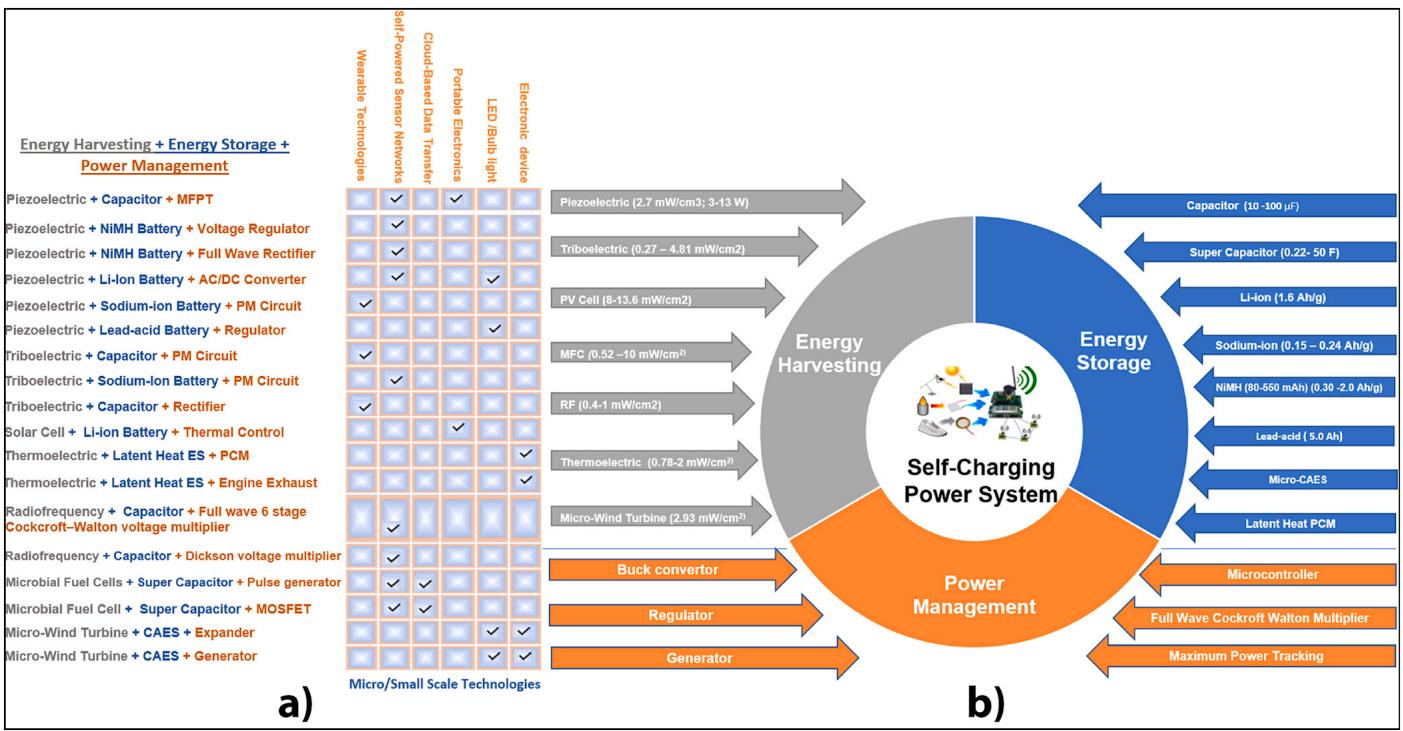
One of the principal NMEH directions is the integration of sensing, power generation, and wireless communication into compact platforms, such as a 3D printed gait analysis system using TENGs and electrospun nanofibers for instantaneous, online measurements of stride and speed [109]. Fig. 7 illustrates how miniaturized low energy harvesting, storage, and power management devices facilitate self-sustaining wireless sensor and wearable technologies with capacitors (0.22–100 μF) and supercapacitors (0.22–100 F) for quick release of energy, lithium-ion and sodium-ion batteries (80–550 mAh) for extended operation, and power-efficient (up to 90 %) power management devices such as buck converters for maximum energy transfer and reliability.
5.2. Challenges in on-chip integration of AM harvesters
Integrating ambient energy harvesting directly onto chip platforms remains technically demanding, particularly when aiming for powerautonomous, battery-less operation in IoT edge devices. Achieving functional co-integration of harvesting units, storage blocks such as supercapacitors or micro-batteries, and micro-power management circuits is constrained by scaling limits. For semi-flexible and flexible hybrids, silicon must be thinned down to 35 μm to enable bending to a 5 mm radius, yet this reduction amplifies risks of cracking, delamination, and reduced energy transfer efficiency. High-precision assembly is required to maintain 95 % transfer printing yields for nanoscale components, but adhesion instabilities become pronounced for Chiplets of ≤ 100 μm, where electrostatic and Van der Waals effects lead to misalignment and failed transfers. Thermal and mechanical mismatches between silicon and polymer substrates further restrict scalability for curved or deformable formats, while the lack of standardized interfaces for multi-source AM harvesting limits performance at high-frequency RF bands required in beyond-5G applications.
Table 1 Overview of AM materials and their performance, applications, and challenges in NMEH.
| Material | Composition | 3D printing method | Key functional performance | NMEH application | Main challenges |
| Semiconductor-polymer nanocomposite [73] | Ga-doped ZnO / photocurable resin | Photopolymerization (LCD/DLP) | Flexible thermoelectric and piezoelectric films; output up to ~3 V | Wearable TE & PE Nanogenerators | Thermal stability; mechanical trade-offs; print uniformity |
| Polymer-matrix composite [74] | MXene / P(VDF-TrFE) | Direct Ink Writing (DIW) | Piezoelectric output (~5.5 V); flexible and stretchable | Wearable nanogenerators and self-powered sensors | Filler aggregation; phase alignment; scalability |
| Polymer-ceramic nanocomposite [75] | PVDF / BaTiO3 | Fused Deposition Modeling (FDM) | High β-phase; d33 ≈ 28 pC/N; >30 V output | Piezoelectric harvesters for consumer devices | Particle agglomeration; poling; warping |
| Piezoceramic [76] | La-doped PZT (PLZT) | Digital Light Processing (DLP) | High piezoelectricity (d33 ≈ 279 pC/N) | High-efficiency piezoelectric harvesters | Brittleness; slurry printability; sintering control |
| Inorganic semiconductor-organic composite [77] | Bi2Te3-based thermoelectric ink | Material extrusion | Seebeck ~288 μV/K; μW-level power | Thermoelectric generators and temperature sensors | Low conductivity; substrate limits; ink control |
Table 2 Overview of Energy Harvesting Sources, Conversion Mechanisms, and Efficiencies.
| Source | Energy Conversion | Efficiency | Ref |
| Bio-Mechanical Energy | Negative joint work to electrical energy | 5 W electrical, -8 W metabolic | [83] |
| Electromagnetic | 102.12 mW at 220 Ω (3.66 mW cm-3g-2) | [84] | |
| Triboelectric | 171.13 μW at 8 MΩ (16.16 μW cm-3g-2) | ||
| Triboelectric | 72 nW RMS (initial), 96 nW RMS after 200,000 cycles, 20.7 μW cm-2peak power density | [85] | |
| Ocean Wave | Dielectric Elastomer Generator | (0.5–1.2 Hz in small-scale tests, equivalent to 0.07–0.25 Hz full-scale) | [86] |
| Electromagnetic (via metamaterial defect) | Power Density: 81.1 W/ m3 (at 2 Hz), 99 W/ m3 (maximum reported) | [87] | |
| Electromagnetic | Mechanical Efficiency: 57 % (max), 46.17 % (avg) | [88] | |
| Harvests wave energy via a resonant dielectric elastomer generator | Wave Energy Conversion Efficiency: 18 % | [89] | |
| Triboelectric | 16.6 mW (Spring-assisted swing structure) | [90] | |
| Railway Track Vibrations | Piezoelectric | 207.67 mW (Doughnut-shaped structure) | [91] |
| Electromagnetic | 250 mW (40–65 % conversion efficiency) | [92] | |
| Electromagnetic (triple-magnet repellent configuration) | 5 V/10 mA (50 mW) | [93] | |
| Road vibration (Profile) | Piezoelectric (PVDF/BaTiO3/GP composite with cross-shaped porous structure) | 60.5 V (open-circuit voltage), 654.2 nA (short-circuit current) | [94] |
| Triboelectric and Electromagnetic | TENG: 7.21 mW, EMG: 0.74 mW (at 5 Hz excitation) | [95] | |
| Hybrid Electromagnetic (Linear and Rotary) | Up to 48 W at 54 km/h on deformable clay-loam soil | [96] | |
| Piezoelectric | Up to 28.6 W at 24 km/h (non-contact magnetic force collector); 16.31 W at 80 km/h (drum transducer); 4.3 W at 90 km/h (RPEH) | [97] | |
| Shock Absorber Vibrations | Suspension to electricity by ball screws, stored in supercapacitors | Peak efficiency: 51.1 % Average efficiency: 36.4 % Achieved an average power output of 3.701 W under 1 Hz–3 mm sinusoidal vibration input. | [98] |
| Suspension to power via helical racks, tree system, stored in supercapacitors | Peak efficiency: 65.02 % Average efficiency: 39.46 % Average power output: 4.25 W (2.5 Hz, 7 mm input). | [99] | |
| Converts suspension vibration to electricity via a ball-screw PMSM system | Peak efficiency: 70.55 % Average efficiency: 58.19 % (sinusoidal), 40.72 %–45.75 % (random road). | [100] | |
| Magnetic Inerter-Based Mechanism | 20 % (peak reduction) | [101] | |
| Wind Energy | Converts wind to power via frictionless nanomagnetic bearings | Power Conversion Efficiency: 26 % at a wind speed of 4.5 m/s, producing 2.59 W | [102] |
| Flexible Flagpole FTENG for Wind Energy | Average power: 1.97 mW (0.36 % conversion efficiency). 113 × enhancement vs. rigid flagpole FTENG (17.4 μW). | [103] | |
| Breeze wind to electricity via stretchable TENG | Average energy conversion efficiency: 7.8 % (at 2.5 m/s). Output: 225 V open-circuit | [104] |
Table 2 (continued )
| Source | Energy Conversion | Efficiency | Ref |
| Hybrid wave/wind harvester: OWC + DE film | voltage, 40 μA short-circuit current (6 m/s wind).Wind turbine: Boosts 12 V DC to 1.46 kV for DE bias via rectifier circuit.Theoretical wind energy utilization: ~50 % of Betz's limit (59 %). | [105] |
Economic and sustainability constraints exacerbate the technical challenges of integrating AM on-chip energy harvesters. The semiconductor industry already invests approximately 20 % of revenues in R&D, and the adoption of hybrid or flexible architectures adds process complexity that can reduce yields. Sustainability concerns further demand recyclable, low-temperature materials, as evidenced by the environmental impact of large-scale electronics production, such as the 1–5 million tons of greenhouse gas emissions generated annually by 40 billion RFID tags. Although CMOS-compatible 2D materials (e.g., MoS₂) can be synthesized at , scalability and performance degradation during transfer limit industrial adoption. In addition, insufficient reliability testing for deformable, multifunctional systems hinders alignment with circular economy regulations. Despite a projected 17 % market recovery in 2024, scalable on-chip AM energy harvesting will require coordinated progress in materials, standards, and industry–academia collaboration, supported by initiatives such as the European Chips Act [111].
6. Resources and methods for 3D printed NMEH systems
6.1. Renewable energy sources for NMEH
NMEH devices printed by 3D are categorized according to sources and conversion mechanisms of energy and thus are amenable to optimal configurations for marine, wearable, or industrial environments [112]. Numerical simulation is highlighted as the primary focus in the most recent research for optimizing structural parameters such as aperture shape and compliant mechanisms for better energy conversion efficiency, especially under dynamic loading conditions such as plane wave excitation [113,114]. For instance, the 3D printed inertial sensor was experimentally and numerically validated for marine use as both an energy harvester and an autonomous underwater vehicle self-sustaining tracker [115].
Advanced materials are critical in enhancing the performance of 3D printed NMEH systems. Although flexibility is offered by organic solar cells to hybrid harvesters, the mechanical energy harvesting application is limited without photo-mechanical transduction. Mahmud et al. [116] demonstrated that the combination of PVDF with BaTiO₃ nanoparticles and Lead zirconate titanate (PZT) greatly enhances piezoelectric performance, enabling high charge output in 3D Printing Piezoelectric Nanogenerators (PENGs) printed through FDM and stereolithography (SLA). These materials will be used in applications like sensors and biomedical implants, and also possibly benefit from electrostatic and electromagnetic harvesting. Additionally, the integration of graphene-based micro-supercapacitors and batteries into NMEH platforms enables on-device power storage, ensuring stable power delivery through the regulation of the output voltage [117].
6.2. 3D printing methods for NMEH fabrication
AM enables the fabrication of nanostructures for NMEHs, with DLP providing high-resolution control, while material extrusion methods such as fused filament fabrication (FFF) support polymer composites but lack sub-micron resolution [118]. Other AM techniques standardized under ASTM F2792 include inkjet printing for multi-material integration and powder bed fusion for metal parts, though nanoscale detail is limited without post-processing [119]. Imprint lithography further enhances AM by enabling low-cost, high-throughput TENG fabrication; for instance, lignin/PVA composites exhibit superior electrical performance to PVA-only devices for sensing and energy harvesting applications [120].
flowchart
graph TD
    A["Energy Harvesting + Energy Storage + Power Management"] --> B["Energy Harvesting"]
    B --> C["Self-Charging Power System"]
    C --> D["Energy Storage"]
    D --> E["Power Management"]

    subgraph A
        F1["Piezoelectric + Capacitor + MFPT"] --> G1["√"]
        F2["Piezoelectric + NiMH Battery + Voltage Regulator"] --> G2["√"]
        F3["Piezoelectric + NiMH Battery + Full Wave Rectifier"] --> G3["√"]
        F4["Piezoelectric + Li-Ion Battery + AC/DC Converter"] --> G4["√"]
        F5["Piezoelectric + Sodium-Ion Battery + PM Circuit"] --> G5["√"]
        F6["Piezoelectric + Lead-acid Battery + Regulator"] --> G6["√"]
        F7["Piezoelectric + Capacitor + PM Circuit"] --> G7["√"]
        F8["Piezoelectric + Sodium-Ion Battery + PM Circuit"] --> G8["√"]
        F9["Piezoelectric + Capacitor + Rectifier"] --> G9["√"]
        F10["Solar Cell + Li-Ion Battery + Thermal Control"] --> G10["√"]
        F11["Thermoelectric + Latent Heat ES + PCM"] --> G11["√"]
        F12["Thermoelectric + Latent Heat ES + Engine Exhaust"] --> G12["√"]
        F13["Radiofrequency + Capacitor + Full wave 6 stage Cockcroft-Walton voltage multiplier"] --> G13["√"]
        F14["Radiofrequency + Capacitor + Dickson voltage multiplier"] --> G14["√"]
        F15["Microbial Fuel Cells + Super Capacitor + Pulse generator"] --> G15["√"]
        F16["Microbial Fuel Cell + Super Capacitor + MOSFET"] --> G16["√"]
        F17["Micro-Wind Turbine + CAES + Expander"] --> G17["√"]
        F18["Micro-Wind Turbine + CAES + Generator"] --> G18["√"]
        G1 --> H1["Piezoelectric (2.7 mW/cm3; 3-13 W)"]
        G2 --> H2["Triboelectric (0.27 - 4.81 mW/cm2)"]
        G3 --> H3["PV Cell (8-13.6 mW/cm2)"]
        G4 --> H4["MFC (0.52 - 10 mW/cm²)"]
        G5 --> H5["RF (0.4-1 mW/cm2)"]
        G6 --> H6["Thermoelectric (0.78-2 mW/cm²)"]
        G7 --> H7["Micro-Wind Turbine (2.93 mW/cm²)"]
        H1 --> I1["Buck converter"]
        H2 --> I2["Regulator"]
        H3 --> I3["Generator"]
        H4 --> I4["Buck converter"]
        H5 --> I5["Buck converter"]
        H6 --> I6["Buck converter"]
        H7 --> I7["Buck converter"]
        H8 --> I8["Buck converter"]
        I1 --> J1["Capacitor (10 - 100 μF)"]
        I2 --> J2["Super Capacitor (0.22 - 50 F)"]
        I3 --> J3["Li-ion (1.6 Ah/g)"]
        I4 --> J4["Sodium-ion (0.15 - 0.24 Ah/g)"]
        I5 --> J5["NiMH (80-550 mAh) (0.30 - 2.0 Ah/g)"]
        I6 --> J6["Lead-acid (5.0 Ah)"]
        I7 --> J7["Micro-CAES"]
        I8 --> J8["Latent Heat PCM"]
        I9 --> J9["Microcontroller"]
        I10 --> K1["Full Wave Cockroft Walton Multiplier"]
        K2 --> K3["Maximum Power Tracking"]
    end

    subgraph B
        L1["Micro/Small Scale Technologies"] --> M1
    end

    subgraph C
        N1["Energy Harvesting + Energy Storage + Power Management"] --> O1["Wearable Technologies"]
        N2["Piezoelectric + Capacitor + MFPT"] --> O2["√"]
        N3["Piezoelectric + NiMH Battery + Voltage Regulator"] --> O3["√"]
        N4["Piezoelectric + NiMH Battery + Full Wave Rectifier"] --> O4["√"]
        N5["Piezoelectric + Li-Ion Battery + AC/DC Converter"] --> O5["√"]
        N6["Piezoelectric + Sodium-Ion Battery + PM Circuit"] --> O6["√"]
        N7["Piezoelectric + Lead-acid Battery + Regulator"] --> O7["√"]
        N8["Piezoelectric + Capacitor + PM Circuit"] --> O8["√"]
        N9["Piezoelectric + Sodium-Ion Battery + PM Circuit"] --> O9["√"]
        N10["Piezoelectric + Capacitor + Rectifier"] --> O10["√"]
        N11["Solar Cell + Li-Ion Battery + Thermal Control"] --> O11["√"]
        N12["Thermoelectric + Latent Heat ES + PCM"] --> O12["√"]
        N13["Thermoelectric + Latent Heat ES + Engine Exhaust"] --> O13["√"]
        N14["Radiofrequency + Capacitor + Full wave 6 stage Cockcroft-Walton voltage multiplier"] --> O14["√"]
        N15["Radiofrequency + Capacitor + Dickson voltage multiplier"] --> O15["√"]
        N16["Microbial Fuel Cells + Super Capacitor + Pulse generator"] --> O16["√"]
        N17["Microbial Fuel Cell + Super Capacitor + MOSFET"] --> O17["√"]
        N18["Micro-Wind Turbine + CAES + Expander"] --> O18["√"]
        N19["Micro-Wind Turbine + CAES + Generator"] --> O19["√"]
    end
Fig. 7. Schematic of studies on a low-energy harvesting system incorporated with an energy harvesting transducer, power management, and energy storage [110] (The image is reused with the permission of the publisher).
FDM is a low-cost, popular method for 3D Printing NMEH fabrication due to its material versatility and scalability. However, its degraded resolution and surface roughness may affect its performance in energy harvesting applications [73]. Here, the 3D printing and operation of a 3D printed nanomaterial-enriched harvester NMEH through DLP is described, a high-resolution vat photopolymerization technique with fast curing and low material waste [121]. Yi et al. [122] demonstrated DLP’s application in creating flexible energy devices like TENGs and PENGs with enhanced output through complex structures, though material biocompatibility issues exist. FDM printed ABS/carbon black composites are characterized by strong electromagnetic interference (EMI) shielding (up to 78 dB) and multifunctionality, such as sensing ability [123]. Additionally, DLP printed Photosensitive polyimide and Polytetrafluoroethylene surfaces that have been optimized using machine learning exhibit remarkable tribological behavior and thermal stability for future-generation self-powered devices [124].
Selective laser sintering (SLS) also has great potential for the production of piezoelectric components from composites and ceramics. Yang et al. [125] fabricated a high-power harvester from PVDF/Ba-TiO₃/CNT composites with a bionic structure, achieving 19.3 V and capacitor charging to 5.03 V in 180 s. Azam et al. [126] achieved better piezoresistive properties in multi-walled carbon nanotubes (MWCNT)/PA12 composites, though high MWCNT loading led to processing problems. Despite its material resilience and resolution, SLS is limited in terms of energy consumption and equipment sophistication for wearable technology or large-scale applications. FDM offers an economical, scalable, rapid prototyping technique for non-critical NMEH components. Cao et al. [127] showed a fully encapsulated microbead TENG array created through FDM having 19.9 µC/m² charge
density and 13.8 W/m³ power density for energy harvesting from wind, wave, and motion. More generic 3D printing advancements like SLS, SLM, and Electron Beam Melting (EBM) enable complex energy components and enable technology like 4D printing with hybrid materials in fuel cells and energy storage [128]. Textile-based energy harvesting is also in progress, with Megdich et al. [129–131] creating a PVDF/MWCNTs Piezoelectric Energy Harvester with a 3D printed auxetic structure that can provide up to 28.2 V and can be used in smart flooring and security systems.
Wei et al. [132] reviewed flexible wearable electronic fabrication methods, with the need for scalable, accurate, and renewable processes. Hazarika et al. [133] 3D printed a Kevlar composite incorporating radiative cooling and TENG capabilities, cooling the skin by 22.2◦C and powering 1.37 mW/cm². Babu et al. [134] 3D printed high-voltage T-TENGs (~193 V) on stretchable fabric via polypropylene, even though Polydimethylsiloxane (PDMS) FDM compatibility assertions require further confirmation. Patil et al. [135] designed an FDM printed RF harvester employing biodegradable polylactic acid (PLA) with high RF-to-DC conversion efficiencies for powering IoT devices at 2.4 and 5.2 GHz.
Hu et al. [136] created topology-optimized 3D printed lithium-ion battery electrodes through FDM and Thermoplastic Polyurethane (TPU) materials with enhanced mechanical durability and 98 % capacity after 50 stretching cycles compared to conventional designs. Surface treatments, such as parallel friction layers, enhanced electromechanical coupling in TENG systems, though operational conditions need to be more thoroughly reported for reproducibility. Overall, FDM offers customization, cost-effectiveness, and quickness for 3D Printing NMEHs but is hindered by material compatibility and resolution. Future research should be focused on comparative studies to establish absolute perfor mance benchmarks between AM techniques [137]. Khan et al. [138] created a silane-coupled Linde Type A zeolite/ polydimethylsiloxane TENG with an output of 120 V, 15 µA, and 42.6 µW/cm², with durability over 30,000 cycles and stability under extreme conditions. It can effectively power devices and monitor human movement, and is therefore suitable for wearable energy harvesting and physiological monitoring.
Multi-material AM facilitates complex internal architectures, including lattice- and metamaterial-inspired structures, enabling high functional density and application-specific performance in fields such as aerospace and biomedical engineering. However, these capabilities are currently limited by critical challenges, including poor interfacial bonding, residual and surface stresses, material incompatibility, and defects arising from mismatches in thermal and mechanical properties, particularly in metal–polymer and metal–ceramic systems. In addition, the lack of dedicated multi-material AM design software, validated finite element frameworks, standardized design rules, and scalable postprocessing methods restricts the full exploitation of AM’s multimaterial and direct-writing capabilities. Consequently, while AM offers clear advancements in design complexity and functionality, overcoming material, process, and software limitations remains essential for realizing fully functional multi-material components [139].
6.3. Specialized 3D printed components for NMEH
Fig. 8a [140] shows 3D printed honeycomb structures for EMI shielding made of PLA incorporated with graphene nanosheets and carbon nanotubes as functional fillers. The porous structure possesses a high electrical conductivity of 110.8 S/m and EMI shielding effectiveness of 53.5 dB, exceeding commercial targets. The design showcases lightweight features (0.4–1.0 g/cm³) and adjustable EMI shielding (35–45 dB) when the pore size is smaller than 1/5 of the incident wavelength. Fig. 8b [141] presents a 3D printed thermoelectric composite with leg geometry optimized for radioisotope thermoelectric generators. Through copper additives, the composite realizes a ZT value of 0.91 for p-type material and improved electrical conductivity, facilitating effective power output for deep space missions. Fig. 8c [142] depicts a thin, flexible hybrid piezoelectric-magnetic self-sensing actuator fabricated by immersion precipitation three-dimensional printing. Through kernel ridge regression optimization, the actuator achieves a crystallinity of 62.1 % and provides a high voltage sensing output of 13 mV/g and a magnetic damping of 1.8 m/s², significantly enhancing vibration control in biomedical applications. Fig. 8.d [143] displays a three-dimensional printed bi-stable asymmetric raceway for a piezoelectric energy harvester, utilizing PLA to harvest ultralow-frequency (1.6–6.2 Hz) energy with a high power density of 14.151–16.163 mW⋅cm⁻³ ⋅g⁻²⋅Hz⁻¹ . Fig. 8e [144] illustrates 3D printed shell-based ferroelectric metamaterials, such as Spinodoids and diamond shellulars, that have been fabricated using a piezoceramic AM platform. These structures possess a piezoelectric constant (d33) of 270 pC/N at a relative density of 0.3, whereas a low dielectric constant enhances their sensitivity for force and thermal sensing applications. Fig. 8f [145] demonstrates a 3D printed TENG based on fused filament fabrication of conductive thermoplastic polyurethane/polylactic acid/- carbon nanotubes/graphene polymer filaments. One-click fabrication of TENG with intricate structures is shown in a self-powered cathodic protection system for marine applications. Fig. 8g [146] displays 3D printed PVDF and PVDF-co-hexafluoropropylene components with 75 % infill patterns (e.g., concentric, cross). The concentric pattern has the highest tensile strength (32.3 MPa for Hydrophobic PVDF, which is appropriate for high-performance, lightweight biomedical parts with enhanced adhesion and less warping.
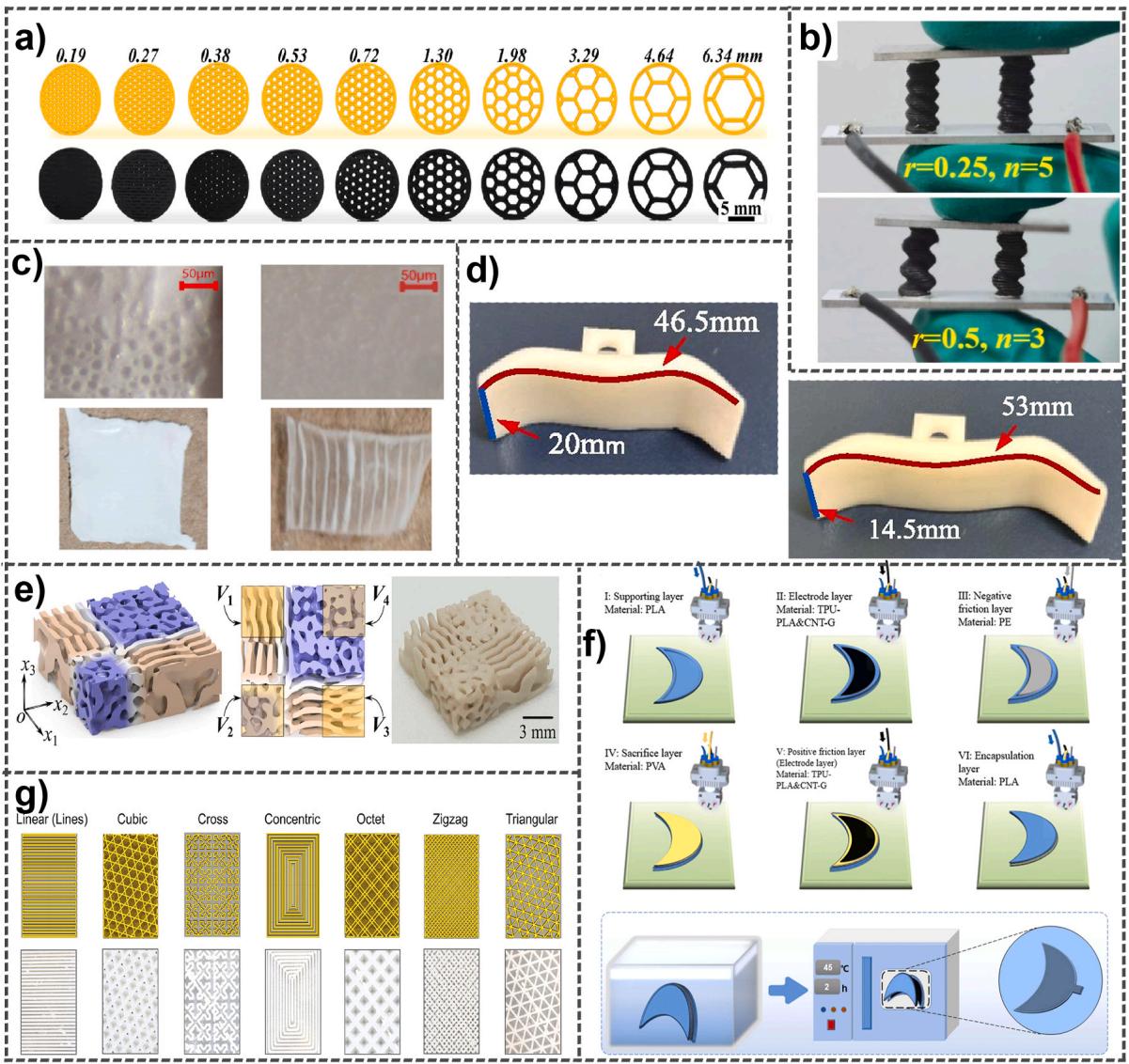
Fig. 8. Illustrations of 3d printing techniques and structures, including a. 3D-Printed architected honeycombs for EMI shielding, b. Thermoelectric composite for generators, c. Hybrid Piezoelectric-Magnetic Self-Sensing Actuator, d. PVDF/ZnO Piezoelectric Energy Harvester, e. shell-based ferroelectric metamaterials, f. 3Dprinted TENG fabricated using FFF, and g. PVDF-based parts for biomedical applications (Images are reused with the permission of the publisher).
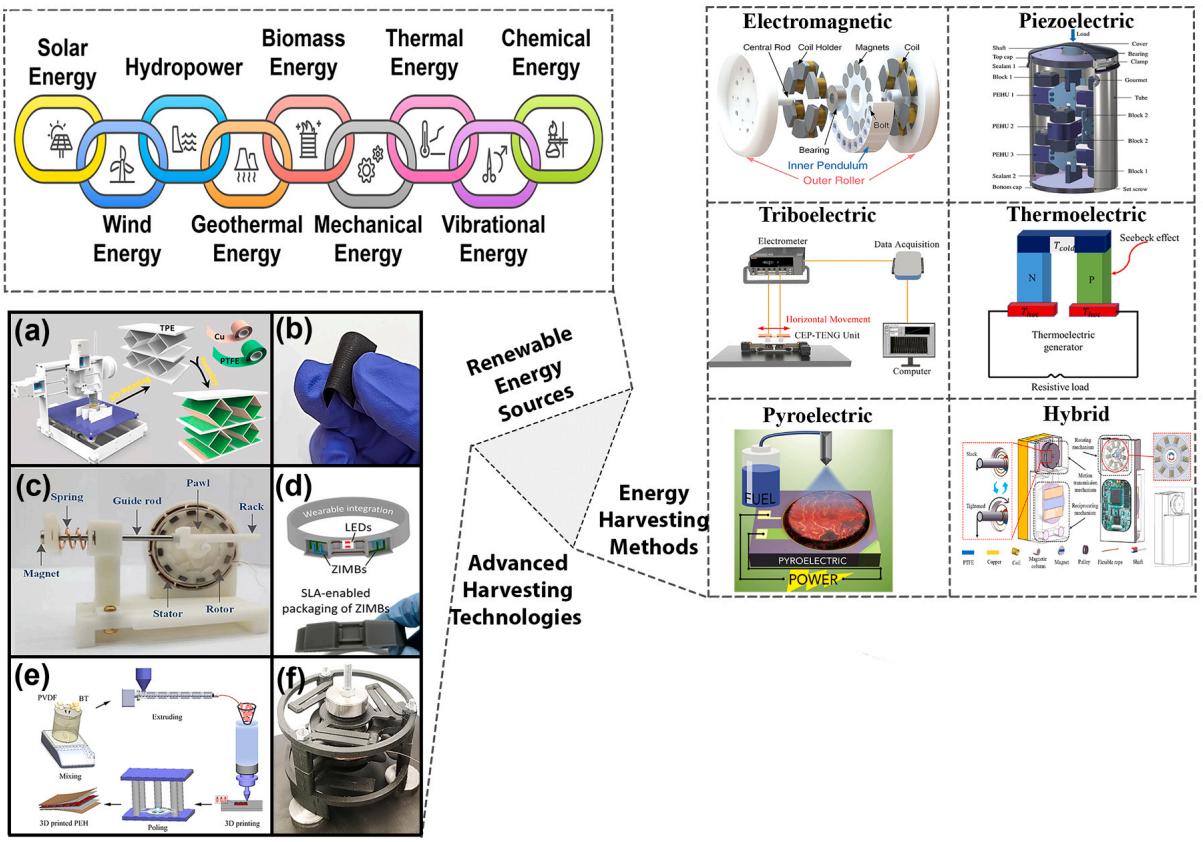
Fig. 9a [147] illustrates a 3D printed TENG with four folding units, achieving a power density of and enabling self-powered N₂ reduction to NH₃ with a yield of 36.41 μg h⁻¹ mg⁻¹cat. Fig. 9b [148] details the Fused Filament Fabrication printing process of 0.2 mm thick, 30 mm square piezoelectric test samples using a Creality C-10 printer with a 0.8 mm hardened steel nozzle at 230◦C, 100◦C bed temperature, and 10 mm/s print speed, alongside neat TPU/CB sensors for comparison, with images of the printing process, a trimmed 25 mm P1 sample, and its flexibility. Fig. 9c [149] presents an archery-inspired catapult mechanism of rotary energy harvesters for ultralow-frequency energy harvesting, achieving a 3.6-fold increase in rotor speed and 3.0-fold increase in output power at 4 Hz. Fig. 9d [150] the figure highlights a 3D printed wearable energy bracelet (65 cm diameter, 12 cm width, 1 mm thick) with zinc-ion micro-batteries and LED lights, fabricated via vat photopolymerization on a Form3 printer, showing smooth packaging and a 2.72 V output powering one or two LEDs. Fig. 9e [75] shows a 3D printed PVDF/BT piezoelectric energy harvester with a bio-inspired 3D structure, generating an open-circuit voltage of 30.8 V and powering a smart mouse. Fig. 9. f [151] depicts a wideband electromagnetic energy
harvester using 3D printed ortho-planar springs, offering a bandwidth of 10–30 Hz and a maximum normalized power density of 2.20 μW .
Fig. 9 Electromagnetic [249] segment details a rolling-swing electromagnetic energy harvester for ultra-low-frequency vibrations, providing milliwatt-level output and powering a thermometer/calculator for 161.3 s at 0.4 g, 1.4 Hz. Fig. 9 Piezoelectric [250] shows a high-density piezoelectric energy harvesting device from highway traffic, achieving an energy density of 15.37 J/(m.pass.lane) with potential for smart highway applications. Fig. 9 Triboelectric [251] illustrates a tubular liquid-solid TENG with coupling electrode pairs, enhancing short-circuit current by 90.9 % to 0.21 μA and output power by 4.82 times for efficient wave energy harvesting. Fig. 9 Thermoelectric [252] depicts a review of thermoelectric microgenerators, highlighting their use in waste heat recovery, with efficiencies up to 57 % in combustion vehicles and applications in bioengineering. Fig. 9 Pyroelectric [253] presents a portable power concept using a pyroelectric generator (PEG) energy conversion with on-chip methanol combustion, achieving an energy density of 48 mJ/cm³ and a 2.5 × power increase at phase transition. Fig. 9 Hybrid [254] illustrates an electromagnetic-triboelectric hybrid energy harvester with vibration-to-rotation conversion, delivering over 800 mW during sprinting to power portable devices.
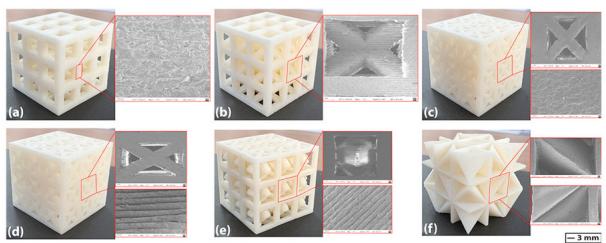
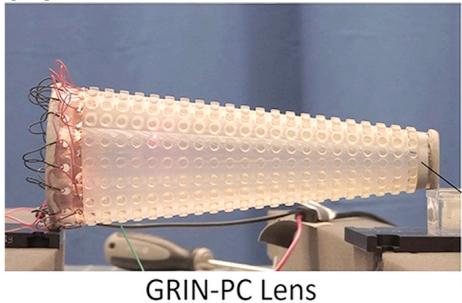
SEM images of FDM printed body-centered cubic (BCC) and other lattice structures (square, FCC, combined, diamond-cubic, tetrahedroncubic). Fig. 10a [152] highlights the surface morphology and mechan ical properties, such as bending stiffness and energy absorption, of such complex lattice structures. Image of a 3D printed conical Gradient index phononic crystal lens, printed with VeroClear in a Stratasys J750 printer, on a 225 mm cone, as highlighted in Fig. 10b [153] actuators
flowchart
graph TD
    A["Solar Energy"] --> B["Hydropower"]
    B --> C["Biomass Energy"]
    C --> D["Thermal Energy"]
    D --> E["Chemical Energy"]

    subgraph Solar_Energy
        F["Wind Energy"] --> G["Geothermal Energy"]
        H["Mechanical Energy"] --> I["Vibrational Energy"]
    end

    subgraph Hydropower
        J["Hydropower"] --> K["Geothermal Energy"]
        L["Geothermal Energy"] --> M["Mechanical Energy"]
        N["Vibrational Energy"] --> O["Chemical Energy"]
    end

    subgraph Biomass_Energy
        P["Hydropower"] --> Q["Geothermal Energy"]
        R["Mechanical Energy"] --> S["Vibrational Energy"]
    end

    subgraph Thermal_Energy
        T["Hydropower"] --> U["Geothermal Energy"]
        V["Mechanical Energy"] --> W["Vibrational Energy"]
    end

    subgraph Chemical_Energy
        X["Hydropower"] --> Y["Geothermal Energy"]
        Z["Mechanical Energy"] --> AA["Vibrational Energy"]
    end

    subgraph Electromagnetic_Energy
        AB["Electromagnetic"] --> AC["Central Rod Coil Holder Magnets Coil"]
        AC --> AD["Bearing Inner Pendulum Outer Roller"]
        AD --> AE["Outer Roller"]
        AE --> AF["Coil"]
        AF --> AG["Bolt"]
        AG --> AH["Outer Roller"]
        AH --> AI["Outer Roller"]
        AI --> AJ["Outer Roller"]
        AJ --> AK["Outer Roller"]
        AK --> AL["Outer Roller"]
        AL --> AM["Outer Roller"]
        AM --> AN["Outer Roller"]
        AN --> AO["Outer Roller"]
        AO --> AP["Outer Roller"]
        AP --> AQ["Outer Roller"]
        AQ --> AR["Outer Roller"]
        AR --> AS["Outer Roller"]
        AS --> AT["Outer Roller"]
        AT --> AU["Outer Roller"]
        AU --> AV["Outer Roller"]
        AV --> AW["Outer Roller"]
        AW --> AX["Outer Roller"]
        AX --> AY["Outer Roller"]
        AY --> AZ["Outer Roller"]
        AZ --> BA["Outer Roller"]
        BA --> BB["Outer Roller"]
        BB --> BC["Outer Roller"]
        BC --> BD["Outer Roller"]
        BD --> BE["Outer Roller"]
        BE --> BF["Outer Roller"]
        BF --> BG["Outer Roller"]
        BG --> BH["Outer Roller"]
        BH --> BI["Outer Roller"]
        BI --> BJ["Outer Roller"]
        BJ --> BK["Outer Roller"]
        BK --> BL["Outer Roller"]
        BL --> BM["Outer Roller"]
        BM --> BN["Outer Roller"]
        BN --> BO["Outer Roller"]
        BO --> BP["Outer Roller"]
        BP --> BQ["Outer Roller"]
        BQ --> BR["Outer Roller"]
        BR --> BS["Outer Roller"]
        BS --> BT["Outer Roller"]
        BT --> BU["Outer Roller"]
        BU --> BV["Outer Roller"]
        BV --> BW["Outer Roller"]
        BW --> BX["Outer Roller"]
        BX --> BY["Outer Roller"]
        BY --> BZ["Outer Roller"]
        BZ --> CA["Outer Roller"]
        CA --> CB["Outer Roller"]
        CB --> CC["Outer Roller"]
        CC --> CD["Outer Roller"]
        CD --> CE["Outer Roller"]
        CE --> CF["Outer Roller"]
        CF --> CG["Outer Roller"]
        CG --> CH["Outer Roller"]
        CH --> CI["Outer Roller"]
        CI --> CJ["Outer Roller"]
        CJ --> CK["Outer Roller"]
        CK --> CR["Outer Roller"]
        CR --> CS["Outer Roller"]
        CS --> CT["Outer Roller"]
        CT --> CU["Outer Roller"]
        CU --> CV["Outer Roller"]
        CV --> CW["Outer Roller"]
        CW --> CX["Outer Roller"]
        CX --> CY["Outer Roller"]
        CY --> CZ["Outer Roller"]
        CZ --> DA["Outer Roller"]
        DA --> DB["Outer Roller"]
        DB --> DC["Outer Roller"]
        DC --> DD["Outer Roller"]
        DD --> DE["Outer Roller"]
        DE --> DF["Outer Roller"]
        DF --> DG["Outer Roller"]
        DG --> DH["Outer Roller"]
        DH --> DI["Outer Roller"]
        DI --> DJ["Outer Roller"]
        DJ --> DK["Outer Roller"]
        DK --> DL["Outer Roller"]
        DL --> DV["Outer Roller"]
    end

    subgraph Renewable_Energy Sources
    E1["(a)"] & E2["(b)"] & E3["(c)"] & E4["(d)"] & E5["(e)"]
    subgraph Advanced_Harvesting_Technologies
    E1 & E2 & E3 & E4 & E5 & E6 & E7 & E8 & E9 & E10 & E11 & E12 & E13 & E14 & E15 & E16 & E17 & E18 & E19 & E20 & E21 & E22 & E23 & E24 & E25 & E26 & E27 & E28 & E29 & E30 & E31 & E32 & E33 & E34 & E35 & E36 & E37 & E38 & E39 & E40 & E41 & E42 & E43 & E44 & E45 & E46 & E47 & E48 & E49 & E50 & E51 & E52 & E53 & E54 & E55 & E56 & E57 & E58 & E59 & E60 & E61 & E62 & E63 & E64 & E65 & E66 & E67 & E68 & E69 & E70 & E71 & E72 & E73 & E74 & E75 & E76 & E77 & E78 & E79 & E80 & E81 & E82 & E83 & E84 & E85 & E86 & E87 & E88 & E89 & E90 & E91 & E92 & E93 & E94 & E95 & E96 & E97 & E98 & E99 & F00
    end

    subgraph Advanced_Harvesting_Technologies
    subgraph Renewable_Energy Sources
    subgraph Advanced_Harvesting_Technologies
    end

    subgraph Advanced_Harvesting_Technologies
    subgraph Advanced_Harvesting_Technologies
    end

    subgraph Advanced_Harvesting_Technologies
    subgraph Advanced_Harvesting_Technologies
    end

    subgraph Advanced_Harvesting_Technologies
    subgraph Advanced_Harvesting_Technologies
    end

    subgraph Advanced_Harvesting_Technologies
    subgraph Advanced_Harvesting_Technifications
    end

    subgraph Advanced_Harvesting_Technifications
    subgraph Advanced_Harvesting_Technifications
    end

    subgraph Advanced_Harvesting_Technifications
    subgraph Advanced_Harvesting_Technifications
    end

    subgraph Advanced_Harvesting_Technifications
    subgraph Advanced_Harvesting_Technifications
    end

    subgraph Advanced_Harvesting_Technifications
    subgraph Advanced_Harvesting_Technolutions
    end

    subgraph Advanced_Harvesting_Technolutions
    subgraph Advanced_Harvesting_Technolutions
    end

    subgraph Advanced_Harvesting_Technolutions
    subgraph Advanced_Harvesting_Technolutions
    end

    subgraph Advanced_Harvesting_Technolutions
    subgraph Advanced_Harvesting_Technolutions
    end

    subgraph Advanced_Harvesting_Technolutions
    subgraph Advanced_Harvesting_Technifications
    end

    subgraph Advanced_Harvesting_Technifications
    subgraph Advanced_Harvesting_Technifications
    end

    subgraph Advanced_Harvesting_Technifications
    subgraph Advanced_Harvesting_Technifications
    end

    subgraph Advanced_Harvesting_Technifications
    subgraph Advanced_Harvesting_Technologies
    end

    subgraph Advanced_Harvesting_Technifications
    subgraph Advanced_Harvesting_Technifications
    end

    subgraph Advanced_Harvesting_Technifications
    subgraph Advanced_Harvesting_Technifications
    end

    subgraph Advanced_Harvesting_Technifications
    subgraph Advanced_Harvesting_Technifications
    end

    subgraph Advanced_Harvesting_Supercalculus_1_1_2_3_4_5_6_7_8_9_10_11_12_13_14_15_16_17_18_19_20_21_22_23_24_25_26_27_28_29_30_31_32_33_34_35_36_37_38_39_40_41_42_43_44_45_46_47_48_49_50_51_52_53_54_55_56_57_58_59_60_61_62_63_64_65_66_67_68_69_70_71_72_73_74_75_76_77_78_79_80_81_82_83_84_85_86_87_88_89_90_91_92_93_94_95_96_97_98_99
    end

    subgraph Advanced_Harvesting_Technifications
    end

    subgraph Advanced_Harvesting_Technifications
    end

    subgraph Advanced_Harvesting_Technifications
    end

    subgraph Advanced_Harvesting_Technifications
    end

    subgraph Advanced_Harvesting_Technifications
    end

    subgraph Advanced_Harvesting_Technifications
    end

    subgraph Advanced_Harvesting_Technifications
    end

    subgraph Advanced_Harvesting_Technifications
    end

    subgraph Advanced_Harvesting_Technifications
    end

    subgraph Advanced_Harvesting_Technifications
    end

    subgraph Advanced_Harvesting_Technifications
    end

    subgraph Advanced_Harvesting_Technifications
    end

    subgraph Advanced_Harvesting_Technifications
    end

    subgraph Intermediate_Energy Sources
      end

    subgraph Intermediate_Technifications
      end

    subgraph Intermediate_Technifications
      end

    subgraph Intermediate_Technifications
      end

    subgraph Intermediate_Technifications
      end

    subgraph Intermediate_Technifications
      end

    subgraph Intermediate_Technifications
      end

    subgraph Intermediate_Technifications
      end

    subgraph Intermediate_Technifications
      end

    subgraph Intermediate_Technifications
      end
Fig. 9. Overview of energy harvesting technologies, including a. Renewable energy sources, b. Energy harvesting methods (Electromagnetics, Piezoelectric, Triboelectric, Thermoelectric, Pyroelectric, Hybrid), and advanced harvesting technologies (a. Basic structure and fabrication process of the PE-TENG with four folding units, b. 3D printed PVDF/TPU sensors combined with carbon black and barium titanate, c. 3D-printed rotary energy harvester, d. wearable energy bracelet integrated with 3D printed, e. Schematic diagram of the manufacture of PVDF/BT PEH, f. 3D printed electromagnetic energy harvester based on ortho-planar springs. (Images are reused with the permission of the publisher).
natural_image
Series of 3D-printed white foam cubes with various internal structures, shown from different angles and surface textures (no text or symbols)
text_image
(c) 3 cm 500 µm 8 µm 20 µm
(e)
text_image
UV Light Printing Platform 3D Prints Resin 3D Printing Anode Cathode Carbon film Flow layer Top layer Pt wire
(b)
natural_image
Experimental setup with a GRIN-PC Lens device on a test bench, showing a grid of circular components mounted on a red wire (no text or symbols visible on the device itself)
(d)
natural_image
Two identical 3D-rendered mechanical components in water, each with colored directional arrows indicating movement or force (no text or symbols)
(f)
natural_image
Two dark gray samples labeled ‘Undried’ placed above a ruler for scale (no text or symbols on the samples themselves)
natural_image
Microscopic view of parallel cylindrical structures with 3mm scale indicator (no text or symbols)
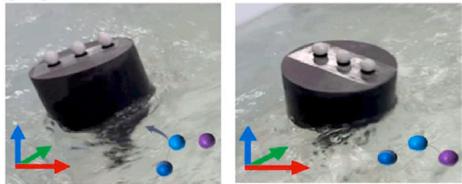
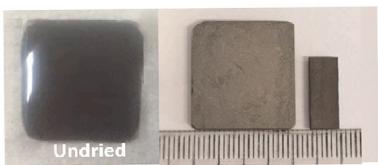
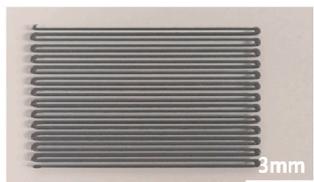
Fig. 10. a. Undried 3D printed samples and their dried counterparts, b. 3D printed speaker and energy harvester, c. Microstructural analysis of a 3D printed leaf-like structure, d. 3D printed energy harvester in water, e. Schematic of the 3D printing process with UV light and a close-up of the printed microstructure, f. 3D printed lattice structures with detailed microstructural views. (Images are reused with the permission of the publisher).
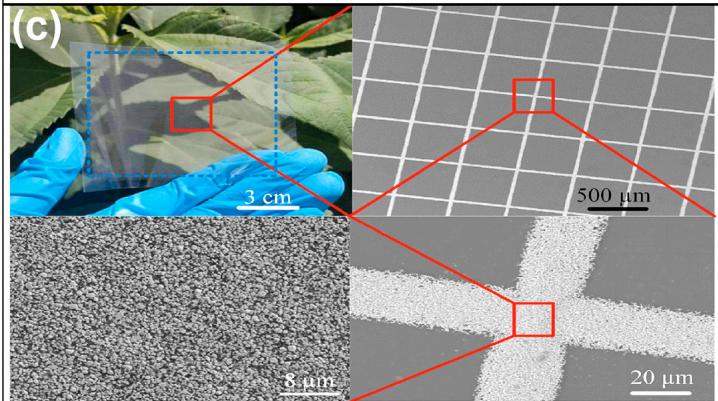
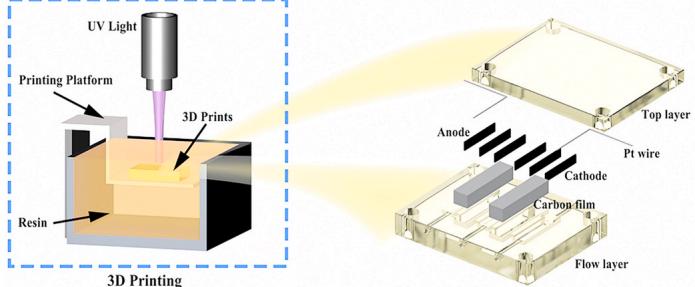
excite 30 kHz L(0,1) modes, with velocity being measured using a Polytec vibrometer on a vibration isolation table. Structural characterization of a silver mesh manufactured by electric-field-driven microscale 3D printing, demonstrating macroscopic morphology, partial sample view, silver particle distribution, and microscopic morphology. Fig. 10c [154] shows the high optical transmittance and EMI shielding efficiency of the flexible transparent film. Design and optimization of a floating model for a cylindrical pellet-based TENG, with buoyancy stability, hull curvature, and pitching motion curves. Fig. 10d [155] demonstrates the use of conductive 3D printing for the optimization of wave energy harvesting efficiency. Schematic of a light-curing 3D printer and an exploded view of a multichannel MFC. Fig. 10e [156] illustrates the new design that enhances energy harvesting capabilities through cascaded multichannel structures for wearable electronics. Photograph of undried and room-temperature-dried samples, with a filament printed using a 100 μm needle. Fig. 10 f [157] illustrates the application of direct-writing 3D printing for the fabrication of shape-controllable thermoelectric devices with complex structures, enabling enhanced output performance through the minimization of heat loss from curved heat sources.
6.4. Process–performance correlations in additive manufacturing nano mechanical energy harvesting
AM resolution strongly affects nanofiller dispersion, surface quality, and energy harvesting efficiency. High-resolution techniques such as
DLP, multiphoton polymerization, and continuous liquid interface production enable uniform nanoscale features, while extrusion-based methods suffer from lower resolution and higher roughness. Sub-10 nm precision via nano displacement lithography enhances nanofiller homogeneity and energy conversion efficiency [158].
Surface functionalization and metallization treatments quantitatively strengthen correlations between printing quality, roughness reduction, and device performance. Functionalized thermoplastics such as PLA and ABS embedded with graphene or carbon fibers exhibit improved dispersion, while dopamine-modified Poly (ethylene glycol) diacrylate structures printed at 137 μm resolution show enhanced uniformity. Screen-printed thermoelectric composites reach ZT values of 0.65 (p-type) and 0.81 (n-type), producing 566 at a 40 K temperature gradient. Metallization processes, including electroless deposition, maintain 50 μm resolutions and achieve 67 μΩ⋅cm resistivity for Ni lines, with surface roughness reduced from 3.96 μm to 1.01 μm via vapor treatment, boosting thermoelectric efficiency to 24.79 %. In piezoelectric and biosensing applications, poly (vinylidene fluoride) with trifluoro ethylene P(VDF-TrFE), resins printed at 40 μm resolution with 500 μm copper lines exhibit post-etching roughness below 0.19 μm, enhancing mechanical energy capture and detection sensitivity down to 11.1 μM for H₂O₂. Optimizing AM parameters—specifically resolution, roughness, and nanofiller dispersion—translates into measurable performance gains in nano mechanical energy harvesting systems. Balanced resolutions between 10–100 μm and controlled filler loading, such as 5 wt% CuC₂O₄ in ABS, improve conductivity and reduce losses. DLPprinted PVDF-TrFE sensors with 40 μm features and ELD-Cu inductors demonstrate stable functionality with 0.26 dB/cm insertion loss at 2 MHz. Screen-printed perovskite-integrated harvesters reach 22.6 % efficiency over , maintaining 70 % conductivity after brief plating. Conductivity values ranging from to and power outputs up to confirm that precise control of printing resolution and nanofiller dispersion governs surface smoothness and ultimately defines real device efficiency in AM-based energy harvesters [159].
6.5. Benefits and drawbacks of 3D printing for NMEH
To critically assess the suitability of AM for NMEH systems, this section outlines the key benefits, drawbacks, and performance benchmarks, with relevant data summarized in Table 3.
6.6. Comparative summary of 3D printing methods for NMEH
Table 4 overviews the primary benefits of AM for NMEH manufacturing—design flexibility, rapid prototyping, and less material waste—with drawbacks such as nanoscale resolution limitations, surface roughness, and material compatibility issues.
7. Applications of 3D printed NMEH systems
AM contributes to sustainability in renewable energy, with 3D printing reducing waste, cost, and CO₂ emissions by ~25 % in wind turbine applications, primarily supporting SDG 7, while broader SDG impacts require further interdisciplinary study [177]. In industrial contexts, 3D-printed NMEH systems enable vibration-based rail monitoring [178], self-powered green desalination structures [179], and autonomous hydrogen production via hybrid electrochemical systems [180]
Yang et al. [181] highlighted how DIW 3D printing has advanced flexible polymer composite batteries for wearables through increased flexibility of integration and design. Key advances include DIW printed electrodes with high flexibility and capacity, SLA printed electrolytes with enhanced conductivity, and DIW printed full cells with high areal capacities, and DIW printed full cells with high areal capacities [182] Challenges are the formulation of ink, resolution at the nanoscale, and tradeoffs between mechanics and energy density, with future work trending toward machine learning and advanced simulation. Tan et al. [183] described that low-cost wearable healthcare devices like patches for electrocardiography can be realized using flexible 3D printed electronics and functional inks on polymer substrates, but mechanical mismatches require special stretchable inks to maintain performance under deformation.
In industrial or environmental settings, energy-autonomous thermal sensors for the selective detection of heat and cold variations were made possible by 3D printed NMEH units [184]. Device structure and printed materials might be optimized for maximum mechanical strength and thermal conductivity to enable viable deployment in temperature-varying environments. In order to enable self-sustaining health and activity monitoring devices, as well as energy-harvesting sensor integration with textiles and flexible substrates for prolonged comfort and long-term functionality, 3D printed NMEH devices offer small, lightweight, and body-fit wearable electronics [185,186]. Triboelectric material and coaxial PTFE and graphene fiber-based stretchable e-textiles generate perpetual power to fabricate breathable, washable electronic skin (e-skin) with tactile sensing [187]. Numerous high-sensitivity sensing applications, such as energy-autonomous optical sensors for structural strain monitoring [188,189], flexible pressure and strain sensors for soft robotics [190,191], tactile interfaces, and wireless structural health monitoring to power wireless nodes in infrastructure, use 3D printed NMEH devices [192]. DIW and DLP have brought AM technologies that have enabled flexible, biocompatible NMEH devices for battery-free biomedical monitoring [193,194]. For example, Wang et al. [195] developed a flexible TENG from waste Perilla straw with 5.7 V generation, an LED power supply, and human motion detection for environment-friendly energy harvesting and monitoring. A flexible thermoelectric-piezoelectric generator integrating piezoelectric PVDF-TrFE film and bismuth telluride alloy blocks for body heat and movement energy harvesting generates 17 V and 3.8 μA at a 3 K temperature difference with stable performance after 1000 bends. Mounted on the fingers, it produced ~8 V and ~6 μA with excellent potential to be used for self-powered wearables for smart
Table 3 Energy Conversion Mechanisms for AM-Enabled Harvesting Systems.
| Energy Conversion Mechanism | Input | Output | Advantages (↑) and Disadvantages (↓) | Ref |
| EMG | ||||
| Portable wind energy harvester based on S-rotor and H-rotor | Wind flow | Electrical energy via electromagnetic induction | ↑ Compact design suitable for low-speed wind; ↓Limited power output at very low wind speeds | [160] |
| Double-Skin Façade system for harvesting wind energy | Building-integrated wind flow | Electrical energy through integrated EMG | ↑ Aesthetic integration into buildings; ↓Efficiency varies with wind availability | [161] |
| Galloping, vortex shedding, flutter, and aerodynamic instability | Wind-induced structural vibrations | Electrical energy via electromagnetic conversion | ↑ Exploits multiple aerodynamic phenomena; ↓Complex dynamics require precise tuning | [162] |
| PENG | ||||
| Flutter of a flexible piezoelectric membrane | Wind-induced flutter | Electrical energy from membrane deformation | ↑ High sensitivity to airflow; ↓ Material fatigue over time | [163] |
| Vortex-induced vibration-based piezoelectric energy harvester | Vortex-induced vibrations from wind or water flow | Electrical energy via the piezoelectric effect | ↑ Broadband energy harvesting; ↓ Performance affected by flow conditions | [164] |
| MEH is composed of permanent magnets, rotor, piezoelectric stack, and flexure mechanism | Mechanical vibrations | Electrical energy through combined mechanisms | ↑ Enhanced energy conversion efficiency; ↓Increased structural complexity | [165] |
| PEG/TEG | ||||
| Flexible vortex generator or turbulator | Combined solar and wind-induced thermal oscillations | Electrical energy via pyroelectric or thermoelectric effects | ↑ Harvests multiple energy sources; ↓ Lower efficiency compared to other methods | [166] |
| Solar & Wind Energy via Thermal Oscillations (PEG) | Ambient temperature fluctuations | Electrical energy from pyroelectric materials | ↑ Utilizes ubiquitous environmental changes; ↓Output power is relatively low | [167] |
| TENGs | ||||
| Multi-Plate Rotary TENG | Rotational mechanical motion | Electrical energy via the triboelectric effect | ↑ High output voltage; ↓ Wear and tear due to mechanical contact | [168] |
| TENG-based windmill composed of nanopillar-array-architected layers | Wind-induced rotation | Electrical energy through enhanced surface interactions | ↑ Increased surface area boosts efficiency; ↓Fabrication complexity | [169] |
| A pendulum-based, high-efficiency TENG. | Oscillatory motion from wind or waves | Electrical energy via pendulum-induced triboelectric effect | ↑ Effective at low-frequency motions; ↓Sensitivity to directional changes | [170] |
Table 4 Summarizes important methods materials and performance measures.
| Method | Material | Harvester Type | Key Parameters | Output | Strengths | Limitations | Ref |
| Direct Metal Printing | Ti-PDMS-Ti | TENG | External resistance: 304 MΩ, Gap distance: 550 μm, PDMS thickness: 50 μm, Cyclic load: up to 2300 N, Frequency: 1 Hz | Max peak voltage: 23 V, Max power: 1.6 mW | Beats Ti-PDMS-Al power output Biocompatible titanium for TKR - Detects knee load imbalance - Scalable for orthopedic implants | PDMS layer wears under high loads High impedance (304 MΩ) complicates digitization | [171] |
| SLS | Nylons + Ag components | TENG | SLS: Laser adjusts crystallinity (Tm 190–201°C, χc 21–38%). | Open circuit voltage: up to 113.6 V, Short-circuit current: up to 26.5 μA | Durable, flexible for mechanical stress | Nylon's moisture absorption impairs performance | [172] |
| - Supports complex 3D printed geometries - Cost-effective, lightweight vs. metals | - Porosity lowers tensile strength - powder recyclability challenges | ||||||
| DLP | BT/HA + HDDA/ TPGDA resins | PENG | DLP: 405 nm, 40 μm layers, 5 s exposure. Slurry: 55 % BT/HA (50/70/90 % BT), 45 % resin. Sintering: 1300°C, 3 h. Load: 24 N, 1 Hz. | Open-circuit voltage: 8 V (porous 90BT/HA), Short-circuit current: 80 nA (porous 90BT/HA) | Low refractive index BT for precise DLP - - High biocompatibility, cell adhesion - - Dielectric constant 518.7 (90BT/HA, 100 kHz) - Stable piezoelectric output for energy, bone repair | Low BT scaffolds: high porosity, low ε - Low-load tests (24 N vs. physiological 100–4000 N) | [173] |
| FDM | PLA/composites + FEP/ABS/PTFE/ Ecoflex | TENG | FDM: PLA filament (1.75 mm diameter), 0.1 mm layer thickness, 20 % fill rate for donut-patterned TENG; Contact-separation mode; Frequency: 3–7 Hz; Device size: ~4 cm2 | Voc: 502 V (PLA/FEP, Ecoflex/ MWCNT) Isc: 75 μA (PLA/PTFE) Power: 105.29 mW/m2 (helical) | Biodegradable PLA lowers environmental impact | Hydroscopic (reduced mechanical integrity) | [174] |
| - Cost-effective, scalable FDM printing - Strong, processable PLA - Versatile: wearable sensors & biomechanical energy harvesters | - Multilayer design complexity - Poor environmental stability (humidity/ conditions) | ||||||
| DIW | BZT-2/PDMS (20 wt %) + Cu tribolayer | TENG | DIW: 2 × 2 cm2, 0.3 mm (3 layers). Print: 1 cm/s, 20 kPa, 0.5 mm. Test: 20 N, 3 Hz. | Open-circuit voltage: 350 V; Short-circuit current: 4.9 μA; Power density: 2.4 W/m2 (at 60 MΩ load resistance) | High output (350 V, 2.4 W/m2) from BZT-2's dielectric properties - Flexible, stretchable (192 % strain) - Stable for 10,000 cycles - 98.54 % material ID accuracy via LSTM | Complex ink prep (degassing, ultrasonication) Humidity/temp sensitive (4.3 % voltage drop, 30–50 % humidity) - Small-scale devices only (2 × 2 cm2) | [175] |
| SLA | Orange resin/CC/ Co3Te4-CoTe2 | Electrochemical | SLA: 1 × 1 cm/4 × 4 mm, 405 nm, IPA, 5 min cure. COT: 70 nm, 3 mg/cm2. Electrolyte: 1 M KOH, 0.5 M H2SO4. LSV: 2 mV/s. | H2O: 0.29 V|1.66 V|1.80 V SCap: 30mF/cm2 (2.7μWh/cm2, 447 mW/cm2) | SLA: 10–100 μm needle arrays COT: Multi-valent Co (HER/ OER/SC) Polymer substrate SC stability: 94.68 % at 2788 cycles | Non-conductive resin needs carbon/COT coating - High resistance (204.6 Ω) - Limited scalability (1 cm2/ 4 mm2 electrodes) | [176] |
clothing and biomedical monitoring [196]. Speech recognition is not discussed here, but similar flexible sensors could possibly enable voice-interactive wearables in the future. A cost-effective, flexible pressure sensor fabricated via FDM using polydimethylsiloxane and conductive polymer exhibits high sensitivity (160 kPa⁻¹ over 0–0.577 kPa), long-term mechanical stability (>4000 cycles), and capability for physiological monitoring applications such as pulse and swallowing detection [197,198]. The same platform enables tunable stiffness control in robotic grippers (15–44 N/m), supporting delicate object manipulation in soft robotics [199]. Future directions for 3D-printed NMEH systems include self-powered sensors, vibration-driven intelligent lighting, autonomous manufacturing, and sustainable healthcare devices integrating energy harvesting and AM, as illustrated in Fig. 11 [200,201].
The incorporation of 3D printing in NMEH systems has the following unique benefits: it provides high flexibility in design for complicated geometries, facilitates rapid prototyping and customization, and allows the creation of lightweight, miniaturized devices with custom designs for specific environments. These features have greatly broadened the practical application of NMEH technologies in a wide range of fields:
7.1. Self-powered electronic sensors
AM has improved self-powered sensors through the incorporation of piezoelectric and triboelectric materials in flexible, multifunctional devices for robotics, wearables, and remote sensing [202,203]. For instance, 3D printed piezoelectric tactile sensor arrays are conformable to irregular surfaces for accurate force sensing in robotic hands, although there are issues with resolution and dynamic accuracy [204]. 4D printing advancements created self-healing triboelectric sensors with shape memory polymers, with an energy density of 56 and concurrent joint sensing, where thermal programming facilitated sensor recovery and improved durability [205,206]. Hybrid 3D/2D printing fabrication has created nano-cellulose paper-based TENGs with excellent electrical output, abrasion resistance, mechanical flexibility, and environmental sustainability, although their long-term cyclic durability requires further investigation [207]. These wearable, personalized, and decentralized devices have potential applications in remote or harsh environments, such as in space, but need to be tested further for radiation tolerance, thermal stability, and mechanical performance before deployment [208].
7.2. Noise cancellation
TENGs have attracted attention for integrating mechanical energy harvesting with acoustic noise reduction, providing multifunctionality in noisy environments [209]. A cylindrical design involving a patterned aluminum layer and rough PDMS spheres maximizes charge generation and maintains passive sound damping via microstructural scattering [210]. Adding a polyurethane sponge matrix with conductive silver nanowires enhances elasticity and low- to mid-frequency noise absorption, yielding ~20 dB noise reduction to ~50 dB with 45 mW peak power for wearable electronics [211]. While showing better promise than conventional noise dampers, more research on frequency response, durability, and noise attenuation is required for widespread use [212].
7.3. Eco-friendly dust adsorption system
A 3D printed biomimetic villus-structured TENG was created for selfpowered dust filtration and air purification, integrating energy harvesting and particle collection into a single device [213]. The use of PTFE powder as the triboelectric material greatly enhanced electrical output—four times in rotational mode and five times in vertical mode [214]. Electrostatic charges at the PTFE–ABS interface facilitated efficient capture of airborne dust through electrostatic attraction [215]. This reusable PTFE–ABS filter is mechanically robust and withstands several cleaning cycles, reducing waste and supporting sustainability, while 3D printing also reduces material waste [216].
7.4. Fiber degumming, wastewater treatment, and smart textile applications
Li et al. demonstrated water-driven and 3D-printed TENG for textile processing and wastewater treatment, achieving high pollutant degradation efficiencies and self-powered operation [217–219,223]. TENG-based sensors integrated into textile machinery and smart textiles enable mechanical energy harvesting for real-time monitoring and wearable health applications, delivering high voltage outputs and usable power densities [218–220,226]. Such developments illustrate the relevance of Nickel-Metal Hydride Energy Harvesting (NMEH) and advanced manufacturing as enablers in making sustainable and autonomous textile systems. In this regard, additive manufacturing, specifically environmentally friendly additive manufacturing techniques such as biodegradable fused deposition modeling, is applicable in low-carbon manufacturing of energy harvesting and sensing systems [221–226]. However, scaling mechanical energy harvesting systems beyond the watt level remains challenging, requiring further advances in materials, printing techniques, and durability for operation in harsh environments [227].
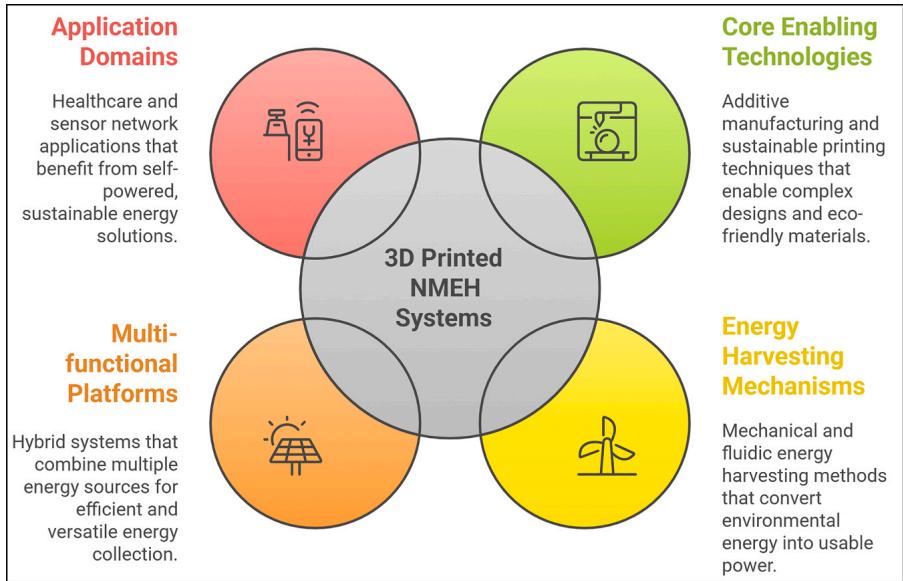
flowchart
graph TD
    A["Application Domains"] --> B["Healthcare and sensor network applications that benefit from self-powered, sustainable energy solutions."]
    C["Core Enabling Technologies"] --> D["Additive manufacturing and sustainable printing techniques that enable complex designs and eco-friendly materials."]
    E["Multi-functional Platforms"] --> F["Hybrid systems that combine multiple energy sources for efficient and versatile energy collection."]
    G["Energy Harvesting Mechanisms"] --> H["Mechanical and fluidic energy harvesting methods that convert environmental energy into usable power."]
    I["3D Printed NMEH Systems"] --> A & C & E & F & G
Fig. 11. Overview of energy harvesting and 3D printing in restorative healthcare engineering.
7.5. Life cycle assessment of AM-NMEH sustainability
The life cycle assessment demonstrates that AM via FFF using carbon-fiber-reinforced nylon coupons can deliver substantial lifecycle environmental benefits when recycled carbon fibers are substituted for virgin fibers. Virgin carbon fiber production emits 420 kg CO₂ equivalent per kg, whereas solvolysis-based recovery reduces this to 143 kg CO₂ equivalent per kg for plasma-enhanced (66 % reduction) and 75.7 kg CO₂ equivalent per kg for supercritical solvolysis (82 % reduction), with 90 % carbon fiber recovery. End-of-life burdens also decrease markedly: landfilling produces 0.11 kg CO₂ equivalent per kg composite, compared with net credits of –37.4 kg CO₂ equivalent for plasmaenhanced and 46.5 kg CO₂ equivalent for supercritical solvolysis. For PA6 coupons, life cycle emissions drop from 1.87 kg equivalent (virgin carbon fiber, landfilling) to 0.98 kg CO₂ equivalent when 75 % recycled carbon fibers are used without functionality loss (48 % reduction), or 1.45 kg CO₂ equivalent with 50 % loss (22 % reduction), with similar patterns for PA12. Process electricity remains a major contributor, with 353 watt-hours consumed per coupon during FFF. Optimizing the printing of five coupons reduces climate-change impacts from 0.93 kg to 0.82 kg CO₂ equivalent per coupon (12 % reduction). Overall, solvolysis-enabled recycling supports circularity and reduces global warming potential by more than 48 % relative to virgin carbon fiber baselines, demonstrating clear net life-cycle environmental advantages for AM-enabled components [228].
8. Challenges and future perspectives
Notwithstanding advancements in integrating AM with NMEH, limitations persist, such as creating printable materials with high energy conversion efficiency [229], long-term durability against cyclic and environmental stresses [230], and scalable, cost-efficient mass producibility [231]. Applied implementation also demands solutions for energy management, user acceptance, and system compatibility. High-resolution advances in AM facilitate the creation of intricate geometries and microstructures [232], whilst material functionalization during printing—e.g., infusing conductive nanoparticles such as carbon nanotubes or graphene—can enhance electrical conductivity by as much as 70 % and mechanical strength [233,234]. In addition, surface treatments and post-processing can enhance triboelectric performance by as much as 30 % [235].
Creating new printable materials is central to enhancing the performance of thermoelectric generators. Tran et al. demonstrated up to 2.39 % efficiency with plasma-sprayed TiO2− x and Li: Co3O4 materials for large-scale, complex-geometry TEGs applicable to waste heat harvesting [236]. High-Seebeck thermoelectric polymers are promising for ambient energy harvesting [237], and biocompatible materials such as silk fibroin and PLA provide the foundation for environmentally friendly biomedical devices [238]. Printable ceramics and hybrid composites are additional 3D printed NMEH functionalities.
The optimum 3D printing method for NMEHs is determined by mechanical robustness, surface resolution, up scalability, materials compatibility, and electric output. SLS, FDM, DLP, and direct metal printing methods are evaluated for TENGs, PENGs, and hybrid harvesters. The performance is improved by geometric optimization—e.g., cantilever beams optimized within ±2 Hz to vibration sources [239] and surface treatments like micropatterning to improve charge 2–3 [240]. Internal geometries such as honeycomb or gyroid infills can increase the efficiency of energy conversion by up to 50 % [241]. AI-assisted design and Multiphysics simulations in the future will allow application-specific optimized NMEH devices.
One of the key priorities in NMEH research is the integration of energy harvesters with micro- and nano-electronics for autonomous sensors, biomedical implants, and IoT devices. This entails matching the intermittent, nonlinear output of MEHs to the constant, low power requirement of electronics using ultra-compact energy conditioning circuits, for example, high-efficiency rectifiers (>90 % conversion), DC-DC converters, and supercapacitor interfaces (designed for printed MEHs’ irregular AC output) [242]. Impedance matching, adaptive power management, on-chip integration, conformal packaging, and wireless energy transfer are also essential to provide glitch-free operation between harvesters and electronics.
8.1. Reliability metrics and failure mechanisms in AM-NMEH
Reliability assessment of nano-mechanical energy harvesters requires understanding how cyclic loading triggers material and structural degradation. In PVDF/MWCNTs-based harvesters, poor filler dispersion, especially near 1 wt%, can introduce pores and surface irregularities that act as stress-intensifying sites, weakening the matrix and accelerating failure under repeated loading. Numerical simulations of contact adhesion layer properties further elucidate how variations in interfacial strength influence delamination risks and overall mechanical integrity in layered AM composites, guiding designs for enhanced cyclic endurance in NMEH systems [243]. Reliability was evaluated through prolonged cyclic compression, where stable output was maintained over 1400 cycles without loss in open-circuit voltage, indicating no observable degradation within that operating window and suggesting good endurance for short-term repetitive use.
Enhancing lifetime further depends on minimizing defect initiation and growth, and encapsulation through controlled 3D printing has proven effective in this regard. Precise tuning of the FDM process provides a protective and uniform enclosure for the active material. A nozzle temperature of was found to yield optimal layer fusion and structural integrity, whereas a drop to 280 ◦C led to weak bonding and pore formation, and an increase to caused over-extrusion, producing blobs and surface irregularities that compromise reliability [75]
8.2. Hardware constraints on AI-driven AM optimization
AI-enabled topology optimization is increasingly being coupled with AM to automate the development of complex geometries, including auxetic architectures that enhance performance and material efficiency. Such approaches accelerate the design–test cycle, as evidenced by an active-learning strategy for 3D micro-printing that required only a few hundred training points to rapidly converge, reducing print errors to within tolerance after four iterations. Data-driven design has also proven effective in process-specific optimization: in FDM, a Random Forest model increased predictive accuracy by over 40 % compared to conventional techniques, supporting the fabrication of parts reaching a tensile strength of around 41 MPa. These outcomes demonstrate the potential of AI-driven optimization to generate structures with improved functionality while significantly cutting down design and calibration effort. Despite these gains, hardware-bound limitations constrain broader adoption and real-time deployment. Vision-based calibration, for example, can reach an average geometric deviation of 0.047 mm, yet remains highly sensitive to environmental variation, and predictive control in wire arc AM, although reducing part height fluctuation by 400 % and improving bead width consistency by 50 %, illustrates the fragility of hardware-integrated intelligence. Model performance also plateaus due to data and transferability gaps: even with defect detection reaching a mean average precision of 91.7 % at ~72 fps, powder-bed classification exceeding 99 %, artificial neural networks (ANNs) correlating with for property prediction, and a convolutional neural network achieving for tensile strength, robustness across different machines is unverified, and the sim-to-real divide persists. Progress will rely on reducing computational load, expanding highquality datasets, and advancing physics-informed and explainable methods to achieve the level of reliability required for certified production, targeting the consistency seen in systems capable of producing ~99.97 % dense parts [244].
To overcome the constraints of PENGs, including the variability of nanofiber diameters and the sub-optimized amount of the β-phase in PVDF films, artificial intelligence assists in the accurate optimization of PENGs via machine learning algorithms trained by the parameters of the PENGs. Artificial Neural Networks (ANNs) accomplish more than 94 % accuracy in the determination of resonance frequencies and the corresponding harvested voltage in M-shaped PENGs, by optimizing parameters including the length of the beam and the weight of the proof mass to decrease the resonant frequencies (reduced from 169 Hz to 110.5 Hz using a deep neural network-genetic algorithm, simultaneously raising the output voltage from 2.5 V to 3.4 V for 0.25 g). For the electrospinning of nanofibers, the accuracy of the ANN models in predicting the polyacrylonitrile nanofiber diameters denotes the predominant significance of the concentration of the solution as well as the applied voltage to produce equal diameters of the nanofibers, meeting the criterion of wearable devices. Fuzzy-logic techniques demonstrate the highest efficiency in predicting the β-phase of spin-coated PVDF (R² = 0.9942, Error = 1.32 %), by optimizing the spinning velocity and the annealing temperature ≤ 60◦C to improve the responses of the devices. By including Finite Element Methods data and genetic algorithms, these strategies overcome the imperfect polarization of PVDF/6H-SiC nanocomposite devices, demonstrating a voltage improvement of 240 % (up to 28.94 V). These strategies together help in the large-scale production of PENGs, showing 371 % greater energy density in self-sustainable sensors and IoT devices, reducing the number of laboratory experiments [245].
9. Conclusion and outlook
The path toward fully functional 3D printed NMEH systems is interdisciplinary, bridging materials science, AM, electronics, and energy systems. The multifaceted technical and systems challenges must be addressed by concurrent advancements in four pillars: (1) printable advanced materials with tunable electromechanical properties; (2) embedded material functionalization methods within additive processes; (3) smart design for geometry-specific energy conversion optimization; and (4) seamless integration in micro/nano systems through customized energy management circuits. A holistic strategy accounting for these interdependencies will propel the implementation of scalable, robust, and application-tailored NMEH technologies for next-generation self-powered systems.
9.1. Summary of current progress
Advanced fabrication approaches have transformed the design of smart structures for nanomaterials and energy harvesting by enabling the production of intricate, application-specific shapes with enhanced energy conversion efficiency. Sophisticated AM fabrication techniques, such as FDM and DIW, offer the potential for precise geometric finetuning and material optimization, including the incorporation of conductive nanoparticles like carbon nanotubes, leading to electrical conductivity enhancements of up to 70 % and mechanical strength improvements. For example, Tran et al.’s plasma-sprayed TiO2 − x-based thermoelectric generators achieved 0.85 % efficiency and 2.43 mW output power at 723 K, with Li: p-type materials further enhancing performance to 2.39 % efficiency. Development of biocompatible materials like PLA and strategies like micropatterned triboelectric layers, which increase surface charge density by further develop NMEH systems for wearable electronics, biomedical implants, and IoT nodes. Despite these advances, challenges remain, including developing scalable, durable printable materials and addressing impedance mismatch for micro/nano-system integration.
9.2. Future outlook for 3D printed NMEH systems
Future advances in 3D-printed NMEH systems will emphasize printable functional materials, high-resolution AM, and efficient powerconditioning electronics to enable practical deployment. Developments such as thermoelectric polymers with Seebeck coefficients exceeding 200 μV/K, biocompatible materials (e.g., silk fibroin), improved SLS and DIW resolution, and AI-assisted geometric optimization are expected to significantly enhance mechanical-to-electrical conversion and IoT integration. Remaining challenges include cyclic durability, material reproducibility, and scalable manufacturing. Ultrasonic field–assisted metal AM shows strong potential for producing reliable NMEH structural components, achieving substantial porosity reduction, grain refinement, crack elimination, and marked improvements in strength, ductility, hardness, and thermal regulation across alloys such as AZ31 Mg, Ti-6Al-4V, NiTi, and AA7075. Optimized ultrasonic parameters and multi-field coupling further support performance gains, positioning these technologies for commercialization aligned with SDG 9 and SDG 12 through enhanced mechanical reliability and sustainable manufacturing.
Wind-Blossom (WB) harvester [246], TENG [247], and flexible piezoelectric materials [248] demonstrate multifunctional approaches that merge towards commercialization by leveraging their individual strengths in various sustainability-driven sectors, simultaneously overcoming major impediments towards commercialization. It is pertinent to note that WB incorporates wind mitigation (49.11 % efficiency), self-sensing , and high electrical power (3.63 W EMG and 143 V TENG), and thus holds great promise for mass implementation within high-speed railway systems, such as China’s massive 45,000 km railway network. Simultaneously, such integration provides an opportunity for potential cost reduction within battery less Internet of Robotic Things nodes, yet still necessitates in-field proof-of-concept tests within intense winds and further AM strategies for cost reduction. These trends and ideas reflect stringent requirements also imposed on TENG, which, despite environmental challenges where humidity-proof designs (such as micropatterned PDMS that preserves 85 % efficiency despite high 80 % relative humidity) and thermal composites (such as PH-SA that boosts performance threefold up to must coexist, still provide robust solutions within maritime applications (such as harvesting an impressive from waves) and automobile detection (functional temperature from up to , thus demanding increased supplementary efforts towards commercialization that also include advancements within the current state of art of two-dimensional materials such as Graphene and MXenes, and the development of standardized measures for degradation sensitivity. Further, flexible piezoelectric materials show compatibility with biological systems and Sustainable Development Goals, as evident in the capability to drive wearable devices with a power rating of 0.3–1 W based on the biomechanical input, with market estimates of approximately USD 27.5 billion in 2026. Its applications relate to the biomedical field, such as implantable biosensors, and combined setups to provide 470 V using ZnO nanowires. Nevertheless, achieving stretchability of up to 300 % using kirigami, enabling wireless integration, and overcoming strain effects to attain a life cycle comparable to that of TENGs (over 86,000 cycles) are required. On combined fronts, the synergistic effect of such properties in the proposed technology, especially in a hybrid setup to achieve continuous value (e.g., piezo-triboelectric with a potential of 60.0 V), appears promising for interdisciplinary research. However, commercialization would require the setting up of standardized metrics for wearability, the development of a self-healing coating layer, and overcoming regulatory barriers necessary for cultivating a supportive IoT ecosystem for environmental sustainability and equality in innovative healthcare.
Funding
The author received no financial support for the research, authorship, and/or publication of this article.
Declaration of Competing Interest
The authors declare that they have no known competing financial interests or personal relationships that could have appeared to influence the work reported in this paper.
Data availability
No data was used for the research described in the article.
References
[1] P. Yan, W. Fan, Y. Han, H. Ding, C. Wen, A.F. Elbarghthi, Y. Yang, Leaf-vein bionic fin configurations for enhanced thermal energy storage performance of phase change materials in smart heating and cooling systems, Appl. Energy 346 (2023) 121352, https://doi.org/10.1016/j.apenergy.2023.121352.
[2] M. Ghaderi, H. Bi, K. Dam-Johansen, Advanced materials for smart protective coatings: Unleashing the potential of metal/covalent organic frameworks, 2D nanomaterials and carbonaceous structures, Adv. Colloid Interface Sci. 323 (2024) 103055, https://doi.org/10.1016/j.cis.2023.103055.
[3] A. de Gracia, J. Tarragona, A. Crespo, C. Fernández, Smart control of dynamic phase change material wall system, Appl. Energy 279 (2020) 115807, https:// doi.org/10.1016/j.apenergy.2020.115807.
[4] V. Sebestyén, Renewable and sustainable energy reviews: environmental impact networks of renewable energy power plants, Renew. Sustain. Energy Rev. 151 (2021) 111626, https://doi.org/10.1016/j.rser.2021.111626.
[5] Q. Hassan, P. Viktor, T. J. Al-Musawi, B.M. Ali, S. Algburi, H.M. Alzoubi, A.K. Al-Jiboory, A.Z. Sameen, H.M. Salman, M. Jaszczur, The renewable energy role in the global energy Transformations, Renew. Energy Focus 48 (2024) 100545, https://doi.org/10.1016/j.ref.2024.100545.
[6] P. Basilico, A. Biancardi, I. D’Adamo, M. Gastaldi, T. Yigitcanlar, Renewable energy communities for sustainable cities: Economic insights into subsidies, market dynamics and benefits distribution, Appl. Energy 389 (2025) 125752, https://doi.org/10.1016/j.apenergy.2025.125752.
[7] H.N.S. Aldin, M.R. Ghods, F. Nayebipour, M.N. Torshiz, A comprehensive review of energy harvesting and routing strategies for IoT sensors sustainability and communication technology, Sens. Int. 5 (2024) 100258, https://doi.org/ 10.1016/j.sintl.2023.100258.
[8] S. Gao, Z. Li, S. Van Petegem, J. Ge, S. Goel, J.V. Vas, V. Luzin, Z. Hu, H.L. Seet, D. F. Sanchez, Additive manufacturing of alloys with programmable microstructure and properties, Nat. Commun. 14 (2023) 6752, https://doi.org/10.1038/s41467- 023-42326-y.
[9] H.H. Shah, C. Tregambi, P. Bareschino, F. Pepe, Environmental and economic sustainability of additive manufacturing: A systematic literature review, Sustain. Prod. Consum. 51 (2024) 628–643, https://doi.org/10.1016/j.spc.2024.10.012.
[10] V.P.N. Samy, F. Brasche, I. Sulˇ ak, ´ B. Verma, B. Nowak, Z. Chlup, T. Z´aleˇz´ak, J. H. Schleifenbaum, U. Krupp, C. Haase, The influence of microstructural heterogeneities on high-temperature mechanical properties of additively manufactured γ’-forming Ni-based alloys, Addit. Manuf. 88 (2024) 104267, https://doi.org/10.1016/j.addma.2024.104267.
[11] K.L. Ameta, V.S. Solanki, V. Singh, A.P. Devi, R. Chundawat, S. Haque, Critical appraisal and systematic review of 3D & 4D printing in sustainable and environment-friendly smart manufacturing technologies, Sustain. Mater. Technol. 34 (2022) e00481, https://doi.org/10.1016/j.susmat.2022.e00481.
[12] W. Dou, H. Wang, J. Liu, M. Han, Q. Li, R. Yang, Three-dimensional flexible structures for miniature sensing and energy-harvesting devices, Appl. Energy 377 (2025) 124455, https://doi.org/10.1016/j.apenergy.2024.124455.
[13] O. Veneri, C. Capasso, S. Patalano, Experimental investigation into the effectiveness of a super-capacitor based hybrid energy storage system for urban commercial vehicles, Appl. Energy 227 (2018) 312–323, https://doi.org/ 10.1016/j.apenergy.2017.08.086.
[14] Z. Ren, L. Wu, Y. Pang, W. Zhang, R. Yang, Strategies for effectively harvesting wind energy based on triboelectric nanogenerators, Nano Energy 100 (2022) 107522, https://doi.org/10.1016/j.nanoen.2022.107522.
[15] X. Du, H. Chen, C. Li, Z. Li, W. Wang, D. Guo, H. Yu, J. Wang, L. Tang, Wake galloping piezoelectric-electromagnetic hybrid ocean wave energy harvesting with oscillating water column, Appl. Energy 353 (2024) 122081, https://doi.org/ 10.1016/j.apenergy.2023.122081.
[16] R. Manghwar, J. Selvaraj, N. Abd Rahim, L. Kumar, H. Khoharo, Global advancements of solar thermoelectric generators application, limitations, and prospects: a comprehensive review, Appl. Therm. Eng. 257 (2024) 124231, https://doi.org/10.1016/j.applthermaleng.2024.124231.
[17] Y. Zhang, J. Liu, J. Zhang, Y. Chen, Y. Zhou, X. Liu, A flexible droplet-based triboelectric-electromagnetic hybrid generator for raindrop energy harvesting, Nano Energy 121 (2024) 109253, https://doi.org/10.1016/j. nanoen.2024.109253.
[18] L. Zhao, B. Qin, C. Fang, L. Liu, P. Poechmueller, X. Yang, Serpentine liquid electrode based Dual-mode skin Sensors: Monitoring biomechanical movements by resistive or triboelectric mode, Chem. Eng. J. 479 (2024) 147898, https://doi. org/10.1016/j.cej.2023.147898.
[19] H. Wei, J. Zhang, Y. Han, D. Xu, Soft-covered wearable thermoelectric device for body heat harvesting and on-skin cooling, Appl. Energy 326 (2022) 119941, https://doi.org/10.1016/j.apenergy.2022.119941.
[20] P. Eghbali, D. Younesian, S. Farhangdoust, Enhancement of the low-frequency acoustic energy harvesting with auxetic resonators, Appl. Energy 270 (2020) 115217, https://doi.org/10.1016/j.apenergy.2020.115217.
[21] L. Dong, G. Hu, J. Yu, C. Zhao, S. Qu, Y. Yang, Maximizing onboard power generation of large-scale railway vibration energy harvesters with intricate vehicle-harvester-circuit coupling relationships, Appl. Energy 347 (2023) 121388, https://doi.org/10.1016/j.apenergy.2023.121388.
[22] L. Zhang, A.-C. Dieudonné, A. Daniilidis, L. Dong, W. Cao, R. Thibaut, L. Tas, T. Hermans, Thermo-hydro-mechanical modeling of geothermal energy systems in deep mines: uncertainty quantification and design optimization, Appl. Energy 377 (2025) 124531, https://doi.org/10.1016/j.apenergy.2024.124531.
[23] T.T.K. Tuoi, N. Van Toan, T. Ono, Thermal energy harvester using ambient temperature fluctuations for self-powered wireless IoT sensing systems: A review, Nano Energy 121 (2024) 109186, https://doi.org/10.1016/j. nanoen.2023.109186.
[24] S. Yin, Y. Li, Z. Zou, T.Q. Bui, J. Liu, S. Gu, G. Zhang, Maximizing band gaps of single-phase phononic plates: Isogeometric optimal approach and 3D printing experimental validation, Appl. Math. Model. 135 (2024) 368–395, https://doi. org/10.1016/j.apm.2024.06.038.
[25] D. Lowell, D. George, J. Lutkenhaus, C. Tian, M. Adewole, U. Philipose, H. Zhang, Y. Lin, Flexible holographic fabrication of 3D photonic crystal templates with polarization control through a 3D printed reflective optical element, Micromachines 7 (2016) 128, https://doi.org/10.3390/mi7070128.
[26] Y. Zhi, X. Li, J. Zhang, L. Zhang, J. Li, W. Zhao, K. Yang, N. Hu, B. Wang, A novel tri-stable piezoelectric vibration energy harvester with an elastic boundary, Mech. Syst. Signal Process. 228 (2025) 112504, https://doi.org/10.1016/j. ymssp.2025.112504.
[27] S. Sun, B. Rankouhi, D.J. Thoma, M.J. Cheadle, G.D. Maples, M.H. Anderson, G. Nellis, X. Qian, Topology optimization, additive manufacturing and thermohydraulic testing of heat sinks, Int. J. Heat. Mass Transf. 224 (2024) 125281, https://doi.org/10.1016/j.ijheatmasstransfer.2024.125281.
[28] G. Gong, Y. You, H. Shen, M. Laghaei, Y. Wang, Y. Li, 3D Printing Piezoelectric Materials: Innovations, Challenges, and Future Perspectives, Mater. Today Sustain. (2025) 101257, https://doi.org/10.1016/j.mtsust.2025.101257.
[29] S. Chattopadhyay, S.D. Mahapatra, N.K. Mandal, Advancements and challenges in additive manufacturing: a comprehensive review, Eng. Res. Express 6 (2024) 012505, https://doi.org/10.1088/2631-8695/ad30b1.
[30] H. Tiismus, A. Kallaste, T. Vaimann, A. Rassolkin, ˜ State of the art of additively manufactured electromagnetic materials for topology optimized electrical machines, Addit. Manuf. 55 (2022) 102778, https://doi.org/10.1016/j. addma.2022.102778.
[31] F. Mehdipour, T. Delrieux, F. Maurer, J.-D. Grunwaldt, C. Klahn, R. Dittmeyer, Opportunities and limitations of metal additive manufacturing of structured catalytic converters, Catal. Commun. 187 (2024) 106873, https://doi.org/ 10.1016/j.catcom.2024.106873.
[32] Y. Shao, B. Luo, T. Liu, C. Cai, X. Meng, S. Wang, S. Nie, Harvesting energy from extreme environmental conditions with cellulosic triboelectric materials, Mater. Today 66 (2023) 348–370, https://doi.org/10.1016/j.mattod.2023.04.006.
[33] X. Yuan, Z. Mai, Z. Li, Z. Yu, P. Ci, S. Dong, A 3D-printing approach toward flexible piezoelectronics with function diversity, Mater. Today 69 (2023) 160–192, https://doi.org/10.1016/j.mattod.2023.08.023.
[34] C. Li, F. He, Y. Wang, H. Guo, Z. Liang, R. Gan, Z.Q. Tian, 3D-braided-electrodebased liquid-solid triboelectric nanogenerator for high-efficiency low-frequency mechanical energy harvesting and angle monitoring, Chem. Eng. J. (2025) 164572, https://doi.org/10.1016/j.cej.2025.164572.
[35] A. Suresh, B. Aljafari, S.B. Thanikanti, Investigations of the performance of 3D printed micro wind turbine composed of PLA material, Heliyon 10 (2024), https://doi.org/10.1016/j.heliyon.2024.e25356.
[36] M. Huang, K. Long, Y. Luo, J. Li, C. Su, X. Gao, S. Guo, Self-charging power module for multidirectional ultra-low frequency mechanical vibration monitoring and energy harvesting, Appl. Energy 361 (2024) 122855, https://doi.org/ 10.1016/j.apenergy.2024.122855.
[37] J. Fu, K. Xia, Z. Xu, Double helix triboelectric nanogenerator for self-powered weight sensors, Sens. Actuators A Phys. 323 (2021) 112650, https://doi.org/ 10.1016/j.sna.2021.112650.
[38] Z. Wang, Z. Chen, B. Wang, C. Wu, C. Zhou, Y. Peng, X. Zhang, Z. Ni, C.-y Chung, C.-c Chan, Digital manufacturing of perovskite materials and solar cells, Appl. Energy 377 (2025) 124120, https://doi.org/10.1016/j.apenergy.2024.124120.
[39] X. Cao, K. Yan, H. Chen, Q. Xu, Y. Zong, X. Sun, X. Li, Passive radiation heating smart fabric with underwater sensor and electromagnetic wave absorption, Appl. Mater. Today 42 (2025) 102550, https://doi.org/10.1016/j.apmt.2024.102550.
[40] M.O. Awadallah, C. Jiang, O. el Moctar, A.A. Hassan, Boosting energy harvesting efficiency from wake-induced vibration using a multi-cylinder configuration, Appl. Energy 381 (2025) 125181, https://doi.org/10.1016/j. apenergy.2024.125181.
[41] L. Zhao, X. Xu, Y. Huang, J. Bai, D. Lv, R. Zhong, D. Yu, X. Wu, 3D-printable hydrophobic silicone inks for antiadhesion tough objects via molecular engineering, Chem. Eng. J. 480 (2024) 147972, https://doi.org/10.1016/j. cej.2023.147972.
[42] R. Zhang, D. Chen, M. Hummelgård, N. Blomquist, C. Dahlstrom, ¨ W. Chen, J. Li, J. Ortegren, ¨ Z.L. Wang, Engineering triboelectric paper for energy harvesting and smart sensing, Adv. Mater. 37 (2025) 2416641, https://doi.org/10.1002/ adma.202416641.
[43] Y. Li, Z. Sun, M. Huang, L. Sun, H. Liu, C. Lee, Self-sustained artificial internet of things based on vibration energy harvesting technology: toward the future ecosociety, Adv. Energy Sustain. Res. 5 (2024) 2400116, https://doi.org/10.1002/ aesr.202400116.
[44] H. Li, S. Liu, X. Wu, S. Yao, X. Hu, Y. Chen, Advances in the device design and printing technology for eco-friendly organic photovoltaics, Energy Environ. Sci. 16 (2023) 76–88, https://doi.org/10.1039/D2EE03246E.
[45] D.I. Kutsarov, E. Rezaee, J. Lambert, W.T. Stroud, A. Panagiotopoulos, S.R. P. Silva, Progress in Flexible Perovskite Solar Cells: Paving the Way for Scalable Manufacturing, Adv. Mater. Technol. (2025) 2401834, https://doi.org/10.1002/ admt.202401834.
[46] E. Galindo, E.R.L. Espiritu, C. Gutierrez, A.N. Alagha, P. Hudon, M. Brochu, A method to assess the quality of additive manufacturing metal powders using the triboelectric charging concept, Sci. Rep. 14 (2024) 16439, https://doi.org/ 10.1038/s41598-024-67295-0.
[47] M.R. Islam, O. Faruk, M.S. Reza, T. Bhatta, M.S. Alam, Z. Islam, S. Lim, J.Y. Park, Amino-rich graphitic carbon nitride functionalized polyurethane nanomesh as highly tribopositive material for high-performance triboelectric nanogenerators and self-powered respiration monitoring wearables, Chem. Eng. J. (2025) 164564, https://doi.org/10.1016/j.cej.2025.164564.
[48] J.-h Son, H. Kim, Y. Choi, H. Lee, 3D printed energy devices: generation, conversion, and storage, Microsyst. Nanoeng. 10 (2024) 93, https://doi.org/ 10.1038/s41378-024-00708-2.
[49] A. Jalali, T. Gupta, V. Pakharenko, Z.B. Rejeb, M. Kheradmandkeysomi, M. Sain, C.B. Park, Lightweight 3D-printed chitosan/MXene aerogels for advanced electromagnetic shielding, energy harvesting, and thermal management, Carbohydr. Polym. 352 (2025) 123252, https://doi.org/10.1016/j. carbpol.2025.123252.
[50] Y.-X. Chen, X.-L. Shi, J.-Z. Zhang, M. Nisar, Z.-Z. Zha, Z.-N. Zhong, F. Li, G.- X. Liang, J.-T. Luo, M. Li, Deviceization of high-performance and flexible Ag2Se films for electronic skin and servo rotation angle control, Nat. Commun. 15 (2024) 8356, https://doi.org/10.1038/s41467-024-52680-0.
[51] A. Baroutaji, A. Arjunan, J. Robinson, M. Ramadan, M.A. Abdelkareem, A. Vance, A. Arafat, A.-G. Olabi, Developments and prospects of additive manufacturing for thermoelectric materials and technologies, Sustain. Mater. Technol. (2024) e01008, https://doi.org/10.1016/j.susmat.2024.e01008.
[52] C. Maduabuchi, K. Okoli, Transient real-weather 4E optimization of two-stage segmented thermoelectric generators for enhanced solar energy conversion, Appl. Energy 373 (2024) 123881, https://doi.org/10.1016/j.apenergy.2024.123881.
[53] Z. Zhou, X. Du, J. Luo, L. Yao, Z. Zhang, H. Yang, Q. Zhang, Coupling of interface effects and porous microstructures in translucent piezoelectric composites for enhanced energy harvesting and sensing, Nano Energy 84 (2021) 105895, https://doi.org/10.1016/j.nanoen.2021.105895.
[54] B. Chen, Z. Feng, F.-Z. Yao, M.-H. Zhang, K. Wang, Y. Wei, W. Gong, J. Rodel,¨ Flexible piezoelectrics: integration of sensing, actuating and energy harvesting, npj Flex. Electron. 9 (2025) 58, https://doi.org/10.1038/s41528-025-00432-5.
[55] A. Mukherjee, P. Zaveri, R. Patel, M.T. Shah, N.S. Munshi, Optimization of microbial fuel cell process using a novel consortium for aromatic hydrocarbon bioremediation and bioelectricity generation, J. Environ. Manag. 298 (2021) 113546, https://doi.org/10.1016/j.jenvman.2021.113546.
[56] Y.A. Begum, S. Kumari, S.K. Jain, M.C. Garg, A review on waste biomass-toenergy: integrated thermochemical and biochemical conversion for resource recovery, Environmental Science Advances 3 (2024) 1197–1216, https://doi.org/ 10.1039/D4VA00109E.
[57] B.K. Panigrahi, R. Ahmed, M.U. Mehmood, J.C. Park, Y. Kim, W. Chun, Operation of a low-temperature differential heat engine for power generation via hybrid nanogenerators, Appl. Energy 285 (2021) 116385, https://doi.org/10.1016/j. apenergy.2020.116385.
[58] A.N. Ravichandran, C. Calmes, J.R. Serres, M. Ramuz, S. Blayac, Compact and high performance wind actuated venturi triboelectric energy harvester, Nano Energy 62 (2019) 449–457, https://doi.org/10.1016/j.nanoen.2019.05.053.
[59] N. Han, D. Zhao, J.U. Schluter, E.S. Goh, H. Zhao, X. Jin, Performance evaluation of 3D printed miniature electromagnetic energy harvesters driven by air flow, Appl. Energy 178 (2016) 672–680, https://doi.org/10.1016/j. apenergy.2016.06.103.
[60] D. Kim, I.-W. Tcho, Y.-K. Choi, Triboelectric nanogenerator based on rolling motion of beads for harvesting wind energy as active wind speed sensor, Nano Energy 52 (2018) 256–263, https://doi.org/10.1016/j.nanoen.2018.07.046.
[61] S. Liu, X. Li, Y. Wang, Y. Yang, L. Meng, T. Cheng, Z.L. Wang, Magnetic switch structured triboelectric nanogenerator for continuous and regular harvesting of wind energy, Nano Energy 83 (2021) 105851, https://doi.org/10.1016/j. nanoen.2021.105851.
[62] S.A. Khan, S. Ali, J. Moon, A. Ali, R. ul Hassan, D.-H. Cho, D. Byun, Multi-energy harvesting: Integrating contact-mode and slide-mode triboelectric nanogenerators, and solar technologies for efficient power generation in small electronic, Energy Rep. 12 (2024) 4232–4240, https://doi.org/10.1016/j. egvr.2024.09.034.
[63] M. Huq, A. Jasi, P. Poure, S. Jovanovic, I. Revol, B. Lenoir, Critical analysis of optimized energy harvesting at small-scale by thermally coupled photovoltaicthermoelectric systems, Renew. Sustain. Energy Rev. 195 (2024) 114331, https:// doi.org/10.1016/j.rser.2024.114331.
[64] S.M. Chang, S. Hur, J. Park, D.G. Lee, J. Shin, H.S. Kim, S.E. Song, J.M. Baik, M. Kim, H.C. Song, C.Y. Kang, Optimization of piezoelectric polymer composites and 3D printing parameters for flexible tactile sensors, Addit. Manuf. 67 (2023), https://doi.org/10.1016/j.addma.2023.103470.
[65] J. Li, Y. Zhang, M. Yan, C. Zhong, L. Zhao, D. Zhai, H. Luo, X. Yuan, D. Zhang, 3D printing of flexible piezoelectric composite with integrated sensing and actuation applications, Adv. Powder Mater. 3 (2024), https://doi.org/10.1016/j. apmate.2024.100226.
[66] N.T. Tasneem, D.K. Biswas, P.R. Adhikari, A. Gunti, A.B. Patwary, R.C. Reid, I. Mahbub, A self-powered wireless motion sensor based on a high-surface area reverse electrowetting-on-dielectric energy harvester, Sci. Rep. 12 (2022) 3782, https://doi.org/10.1038/s41598-022-07631-4.
[67] N.U.H.L. Ali, P. Pazhamalai, A. Sathyaseelan, T.D. Dongale, S.-J. Kim, A selfintegration via dual-active mode structural-SC-TENG energy device for electrochemical energy storage and triboelectric energy harvesting, Appl. Energy 376 (2024) 124265, https://doi.org/10.1016/j.apenergy.2024.124265.
[68] B. Zhang, Z. Zhao, Y. Li, X. Zhang, X. Li, D. Hao, Z. Zhang, Design and analysis of a piezoelectric energy harvesting shock absorber for light truck applications, Appl. Energy 377 (2025) 124569, https://doi.org/10.1016/j. apenergy.2024.124569.
[69] R. Mondal, M.A.M. Hasan, J.M. Baik, Y. Yang, Advanced pyroelectric materials for energy harvesting and sensing applications, Mater. Today 66 (2023) 273–301, https://doi.org/10.1016/j.mattod.2023.03.023.
[70] B. Beltr´an-Pitarch, F. Vidan, M. Carbo, ´ J. García-Canadas, ˜ Impedance spectroscopy analysis of thermoelectric modules under actual energy harvesting operating conditions and a small temperature difference, Appl. Energy 364 (2024) 123104, https://doi.org/10.1016/j.apenergy.2024.123104.
[71] S. Paul, D. Lee, K. Kim, J. Chang, Nonlinear modeling and performance testing of high-power electromagnetic energy harvesting system for self-powering transmission line vibration deicing robot, Mech. Syst. Signal Process. 151 (2021) 107369, https://doi.org/10.1016/j.ymssp.2020.107369.
[72] M. Sheikholeslami, Z. Khalili, F. Salehi, L. Momayez, Simulation of sustainable solar thermal storage system involving photovoltaic panel equipped with nanofluid-based splitter considering self-cleaning coating, Sustain. Cities Soc. 119 (2025) 106100, https://doi.org/10.1016/j.scs.2024.106100.
[73] A.S. Lemine, J. Bhadra, K.K. Sadasivuni, A. Popelka, S. Yempally, Z. Ahmad, N. J. Al-Thani, A. Hasan, 3D printing flexible Ga-doped ZnO films for wearable energy harvesting: thermoelectric and piezoelectric nanogenerators, Journal Materials Science Materials Electronics 35 (2024), https://doi.org/10.1007/ s10854-024-13372-z.
[74] C. Li, Z. Huang, L. Zhang, Z. Song, Y. Chen, X. Chang, P. Hu, 3D printing enhanced piezoelectricity of MXene/P (VDF-TrFE) composites for energy harvesting and force sensing, Compos. Sci. Technol. 258 (2024) 110881, https:// doi.org/10.1016/j.compscitech.2024.110881.
[75] A. Megdich, M. Habibi, L. Laperri`ere, Z. Li, Y. Abdin, Advanced 3D-printed PVDF/ BT piezoelectric energy harvester with a bio-inspired 3D structure for a selfpowered smart mouse, Nano Energy 128 (2024), https://doi.org/10.1016/j. nanoen.2024.109876.
[76] C.-L. Liu, Q. Du, J.-M. Wu, G. Zhang, Y.-S. Shi, Novel 3D printed PZT-based piezoceramics for piezoelectric energy harvesting via digital light processing, Chem. Eng. J. 492 (2024) 152004, https://doi.org/10.1016/j.cej.2024.152004.
[77] G.-P. Cui, C.-P. Feng, S.-C. Xu, K.-Y. Sun, J.-C. Ji, L. Hou, H.-B. Lan, H.-J. Shang, F.-Z. Ding, 3D-printed Bi2Te3-based thermoelectric generators for energy harvesting and temperature response, ACS Appl. Mater. Interfaces 16 (2024) 35353–35360, https://doi.org/10.1021/acsami.4c07013.
[78] S. Badatya, M.K. Patel, M.K. Gupta, Unveiling a robust and high-temperaturestable two-dimensional ZnAl layered double hydroxide nanosheet based flexible triboelectric nanogenerator, Nanoscale 16 (2024) 4176–4188, https://doi.org/ 10.1039/d3nr03894g.
[79] S. Xu, J. Zhang, E. Su, C. Li, W. Tang, G. Liu, L.N. Cao, Z.L. Wang, Dynamic behavior and energy flow of floating triboelectric nanogenerators, Appl. Energy 367 (2024) 123468, https://doi.org/10.1016/j.apenergy.2024.123468.
[80] Q. Li, L. He, X. Lv, Z. Liu, Z. Li, W. Fan, A piezoelectric energy harvester based on center of gravity shift, Appl. Energy 377 (2025) 124394, https://doi.org/ 10.1016/j.apenergy.2024.124394.
[81] J.C. Camara-Molina, ´ E. Moliner, M.D. Martínez-Rodrigo, D.P. Connolly, D. Yurchenko, P. Galvín, A. Romero, 3D printed energy harvesters for railway bridges-Design optimisation, Mech. Syst. Signal Process. 190 (2023) 110133, https://doi.org/10.1016/j.ymssp.2023.110133.
[82] M. Liu, F. Qian, J. Mi, L. Zuo, Biomechanical energy harvesting for wearable and mobile devices: State-of-the-art and future directions, Appl. Energy 321 (2022) 119379, https://doi.org/10.1016/j.apenergy.2022.119379.
[83] M. Gad, B. Lev-Ari, A. Shapiro, C. Ben-David, R. Riemer, Biomechanical knee energy harvester: Design optimization and testing, Front. Robot. AI 9 (2022) 998248, https://doi.org/10.3389/frobt.2022.998248.
[84] M.T. Rahman, S.S. Rana, M. Salauddin, P. Maharjan, T. Bhatta, H. Kim, H. Cho, J. Y. Park, A highly miniaturized freestanding kinetic-impact-based non-resonant hybridized electromagnetic-triboelectric nanogenerator for human induced vibrations harvesting, Appl. Energy 279 (2020) 115799, https://doi.org/ 10.1016/j.apenergy.2020.115799.
[85] T. Busolo, P.K. Szewczyk, M. Nair, U. Stachewicz, S. Kar-Narayan, Triboelectric yarns with electrospun functional polymer coatings for highly durable and washable smart textile applications, ACS Appl. Mater. Interfaces 13 (2021) 16876–16886, https://doi.org/10.1021/acsami.1c00983.
[86] M. Righi, G. Moretti, D. Forehand, L. Agostini, R. Vertechy, M. Fontana, A broadbanded pressure differential wave energy converter based on dielectric
elastomer generators, Nonlinear Dyn. 105 (2021) 2861–2876, https://doi.org/ 10.1007/s11071-021-06721-8.
[87] Z.-Q. Lu, L. Zhao, H.-L. Fu, E. Yeatman, H. Ding, L.-Q. Chen, Ocean wave energy harvesting with high energy density and self-powered monitoring system, Nat. Commun. 15 (2024) 6513, https://doi.org/10.1038/s41467-024-50926-5.
[88] Q. Xie, T. Zhang, Y. Pan, Z. Zhang, Y. Yuan, Y. Liu, A novel oscillating buoy wave energy harvester based on a spatial double X-shaped mechanism for self-powered sensors in sea-crossing bridges, Energy Convers. Manag. 204 (2020) 112286, https://doi.org/10.1016/j.enconman.2019.112286.
[89] W. Yang, J. Peng, Q. Chen, S. Zhao, R. Zhuo, Y. Luo, L. Gao, Advancements and future prospects in ocean wave energy harvesting technology based on microenergy technology, Micromachines 15 (2024) 1199, https://doi.org/10.3390/ mi15101199.
[90] X. Liang, Z. Liu, Y. Feng, J. Han, L. Li, J. An, P. Chen, T. Jiang, Z.L. Wang, Spherical triboelectric nanogenerator based on spring-assisted swing structure for effective water wave energy harvesting, Nano Energy 83 (2021) 105836, https:// doi.org/10.1016/j.nanoen.2021.105836.
[91] Z. Min, X. Du, X. Zhang, W. Wu, X. Shan, T. Xie, Picking up railway track vibration energy using a novel doughnut-shaped piezoelectric energy harvester, Energy 310 (2024) 133183, https://doi.org/10.1016/j.energy.2024.133183.
[92] M. Gao, J. Cong, J. Xiao, Q. He, S. Li, Y. Wang, Y. Yao, R. Chen, P. Wang, Dynamic modeling and experimental investigation of self-powered sensor nodes for freight rail transport, Appl. Energy 257 (2020) 113969, https://doi.org/10.1016/j. apenergy.2019.113969.
[93] Y. Sun, P. Wang, J. Lu, J. Xu, P. Wang, S. Xie, Y. Li, J. Dai, B. Wang, M. Gao, Rail corrugation inspection by a self-contained triple-repellent electromagnetic energy harvesting system, Appl. Energy 286 (2021) 116512, https://doi.org/10.1016/j. apenergy.2021.116512.
[94] S. Song, Y. Han, Y. Li, Q. Wang, 3D printed piezoelectric porous structure with enhanced output performance and stress-electricity response for road energy harvesting, Addit. Manuf. 72 (2023), https://doi.org/10.1016/j. addma.2023.103625.
[95] S. Liu, S. Liao, D. Liu, W. Qing, K. Wei, L. Zhao, H. Zou, A compact hybridized triboelectric-electromagnetic road energy harvester for vehicle speed measurement, DeCarbon 3 (2024) 100036, https://doi.org/10.1016/j. decarb.2024.100036.
[96] H. Taghavifar, A novel energy harvesting approach for hybrid electromagneticbased suspension system of off-road vehicles considering terrain deformability, Mech. Syst. Signal Process. 146 (2021) 106988, https://doi.org/10.1016/j. ymssp.2020.106988.
[97] M. Zhou, L. Wang, J. Wang, G. Ding, Z. Liu, Research progress and latest achievements of road piezoelectric vibration energy capture technology based on intelligent transportation construction, Intell. Transp. Infrastruct. 2 (2023) liad014, https://doi.org/10.1093/iti/liad014.
[98] Z. Wang, T. Zhang, Z. Zhang, Y. Yuan, Y. Liu, A high-efficiency regenerative shock absorber considering twin ball screws transmissions for application in rangeextended electric vehicles, Energy Built Environ. 1 (2020) 36–49, https://doi. org/10.1016/j.enbenv.2019.09.004.
[99] H. Li, P. Zheng, T. Zhang, Y. Zou, Y. Pan, Z. Zhang, A. Azam, A high-efficiency energy regenerative shock absorber for powering auxiliary devices of new energy driverless buses, Appl. Energy 295 (2021) 117020, https://doi.org/10.1016/j. apenergy.2021.117020.
[100] S. Li, J. Xu, X. Pu, T. Tao, X. Mei, A novel design of a damping failure free energyharvesting shock absorber system, Mech. Syst. Signal Process. 132 (2019) 640–653, https://doi.org/10.1016/j.ymssp.2019.07.004.
[101] Z. Sun, J. Zhao, C. Zhang, S. Yuan, J. Luo, H. Pu, Investigation of a novel magnetic inerter-based absorber under shock load, J. Sound Vib. 597 (2025) 118793, https://doi.org/10.1016/j.jsv.2024.118793.
[102] S. Pathak, R. Zhang, B. Gayen, V. Kumar, H. Zhang, R. Pant, X. Wang, Ultra-low friction self-levitating nanomagnetic fluid bearing for highly efficient wind energy harvesting, Sustain. Energy Technol. Assess. 52 (2022) 102024, https://doi.org/ 10.1016/j.seta.2022.102024.
[103] Y. Zhang, S.-C. Fu, K.C. Chan, D.-M. Shin, C.Y. Chao, Boosting power output of flutter-driven triboelectric nanogenerator by flexible flagpole, Nano Energy 88 (2021) 106284, https://doi.org/10.1016/j.nanoen.2021.106284.
[104] Z. Ren, Z. Wang, Z. Liu, L. Wang, H. Guo, L. Li, S. Li, X. Chen, W. Tang, Z.L. Wang, Energy harvesting from breeze wind (0.7–6 m s− 1) using ultra-stretchable triboelectric nanogenerator, Adv. Energy Mater. 10 (2020) 2001770, https://doi. org/10.1002/aenm.202001770.
[105] X. Du, L. Du, X. Cai, Z. Hao, X. Xie, F. Wu, Dielectric elastomer wave energy harvester with self-bias voltage of an ancillary wind generator to power for intelligent buoys, Energy Convers. Manag. 253 (2022) 115178, https://doi.org/ 10.1016/j.enconman.2021.115178.
[106] C. Zhang, R.L. Harne, B. Li, K. Wang, Harmonic analysis and experimental validation of bistable vibration energy harvesters interfaced with rectifying electrical circuits, Commun. Nonlinear Sci. Numer. Simul. 82 (2020) 105069, https://doi.org/10.1016/j.cnsns.2019.105069.
[107] H. Chen, S. Pilla, G. Li, M.W. Ijeoma, M. Carbajales-Dale, Electricity use in big area additive manufacturing of fiber-reinforced polymer composites, Sci. Data 11 (2024) 1362, https://doi.org/10.1038/s41597-024-04240-w.
[108] H.J. Jung, S. Nezami, S. Lee, Power supply switch circuit for intermittent energy harvesting, Electronics 8 (2019) 1446, https://doi.org/10.3390/ electronics8121446.
[109] S. Vennam, K. Vijayasankar, F. Pati, 3D printed personalized assistive devices: a material, technique, and medical condition perspective, Appl. Mater. Today 40 (2024) 102403, https://doi.org/10.1016/j.apmt.2024.102403.
[110] K. Calautit, D.S. Nasir, B.R. Hughes, Low power energy harvesting systems: State of the art and future challenges, Renew. Sustain. Energy Rev. 147 (2021) 111230, https://doi.org/10.1016/j.rser.2021.111230.
[111] K. Rogdakis, G. Psaltakis, G. Fagas, A. Quinn, R. Martins, E. Kymakis, Hybrid chips to enable a sustainable internet of things technology: opportunities and challenges, Discov. Mater. 4 (2024) 4, https://doi.org/10.1007/s43939-024- 00074-w.
[112] S.S. Rana, O. Faruk, M.R. Islam, T. Yasmin, K. Zaman, Z.L. Wang, Recent advances in metal-organic framework-based self-powered sensors: A promising energy harvesting technology, Coord. Chem. Rev. 507 (2024) 215741, https://doi.org/ 10.1016/j.ccr.2024.215741.
[113] K. Bun, S. Rapaka, S. Pathak, A. Date, X. Wang, Additive manufacturing, topology optimization of thermoelectric generators, and beyond: a comprehensive review on pioneering thermoelectric conversion for a sustainable future, Appl. Therm. Eng. (2025) 127437, https://doi.org/10.1016/j.applthermaleng.2025.127437.
[114] N. Vostrov, A. Solnyshkin, I. Morsakov, A. Belov, Structure and pyroelectric properties of PVDF ferroelectric films obtained by 3D printing, Ferroelectrics 612 (2023) 95–101, https://doi.org/10.1080/00150193.2023.2211293.
[115] Q. Feng, Z. Cheng, H. Guo, Y. Wang, S. Zou, D. Liu, L.N. Cao, Y. Mao, C. Zhao, Fully self-powered flexible sensing system via coupled energy harvesting for adolescent skipping rope health monitoring, Chem. Eng. J. (2025) 165175, https://doi.org/10.1016/j.cej.2025.165175.
[116] M.A.P. Mahmud, P. Adhikary, A. Zolfagharian, S. Adams, A. Kaynak, A. Z. Kouzani, Advanced Design, Fabrication, and Applications of 3D-Printable Piezoelectric Nanogenerators, Electron. Mater. Lett. 18 (2022) 129–144, https:// doi.org/10.1007/s13391-021-00327-3.
[117] C.Y. Chen, S. Sayyar, J. Chung, G.Y. Chen, G.G. Wallace, 3D-Printed PDMS/ Graphene Sensors with Tunable Sensitivity via Temperature-Induced Crosslinking for Pressure Applications, Adv. Electron. Mater. (2024), https://doi.org/10.1002/ aelm.202400653.
[118] X. Ren, J. Wang, Y. Wu, Y. Zhang, J. Zhang, L. Bai, J. Liu, G. Li, P. Song, Z. Shi, One-pot synthesis of hydroxyapatite hybrid bioinks for digital light processing 3D printing in bone regeneration, J. Mater. Sci. Technol. 188 (2024) 84–97, https:// doi.org/10.1016/j.jmst.2024.01.001.
[119] A.P. Kolluri, Multi-material additive manufacturing and future scope and expected progress. Multi-material Additive Manufacturing, Elsevier, 2025, pp. 373–402.
[120] S.A. Khan, M.A. Ahmed, M.M. Baig, M.M. Rehman, Y. Yang, S.G. Lee, J.W. Choi, W.Y. Kim, 3D hierarchical microcubic morphological composite and its application for Bi-functional Humidity/Pressure sensing in TENG architecture, Chem. Eng. J. 485 (2024) 149660, https://doi.org/10.1016/j.cej.2024.149660.
[121] X. Zhou, W. Ma, H. Gao, C. Wang, C. Samarth, S. Kongparakul, N.M.A. Tran, J. Wang, X. Liu, H. Tan, H. Zhang, Air-coupled ultrasonic transducer based on lead-free piezoceramics prepared by digital light processing 3D printing, Ultrasonics 143 (2024), https://doi.org/10.1016/j.ultras.2024.107429.
[122] J. Yi, S. Yang, L. Yue, I.M. Lei, Digital light processing 3D printing of flexible devices: actuators, sensors and energy devices, Microsyst. Nanoeng. 11 (2025) 51, https://doi.org/10.1038/s41378-025-00885-8.
[123] N. Jayanth, P. Senthil, B. Mallikarjuna, Experimental investigation on the application of FDM 3D printed conductive ABS-CB composite in EMI shielding, Radiat. Phys. Chem. 198 (2022) 110263, https://doi.org/10.1016/j. radphyschem.2022.110263.
[124] X. Yao, Y. Guo, Y. Gao, K.R. Hossain, Z. Ji, Z. Lu, X. Wang, Q. Wang, F. Zhou, Additive manufacturing patterned self-lubricating polyimide surfaces, Tribology Int. 189 (2023) 108972, https://doi.org/10.1016/j.triboint.2023.108972.
[125] C. Yang, S. Song, F. Chen, N. Chen, Fabrication of PVDF/BaTiO3/CNT piezoelectric energy harvesters with bionic balsa wood structures through 3D printing and supercritical carbon dioxide foaming, ACS Appl. Mater. Interfaces 13 (2021) 41723–41734, https://doi.org/10.1021/acsami.1c11843.
[126] M.U. Azam, I. Belyamani, A. Schiffer, S. Kumar, K. Askar, Progress in selective laser sintering ofmultifunctional polymer composites for strain-and self-sensing applications, J. Mater. Res. Technol. 30 (2024) 9625–9646, https://doi.org/ 10.1016/j.jmrt.2024.06.024.
[127] L.N.Y. Cao, E. Su, Z. Xu, Z.L. Wang, Fully enclosed microbeads structured TENG arrays for omnidirectional wind energy harvesting with a portable galloping oscillator, Mater. Today 71 (2023) 9–21, https://doi.org/10.1016/j. mattod.2023.11.001.
[128] S.F. Acquah, 3D Printing for Energy-Based Applications. Handbook of Nanomaterials and Nanocomposites for Energy and Environmental Applications, Springer, 2021, pp. 1899–1924.
[129] A. Megdich, M. Habibi, L. Laperri`ere, Z. Li, Y. Abdin, Enhanced piezoelectric performance of PVDF/MWCNTs energy harvester through a 3D-printed multimodal auxetic structure for smart security systems, Mater. Today Sustain. 27 (2024), https://doi.org/10.1016/j.mtsust.2024.100847.
[130] J. Jafferson, M. Sabareesh, B. Sidharth, 3D printed fabrics using generative and material Driven design, Mater. Today. Proc. 46 (2021) 1319–1327, https://doi. org/10.1016/j.matpr.2021.02.405.
[131] J.P. Manaia, F. Cerejo, J. Duarte, Revolutionising textile manufacturing: a comprehensive review on 3D and 4D printing technologies, Fash. Text. 10 (2023) 20, https://doi.org/10.1186/s40691-023-00339-7.
[132] R. Wei, H. Li, Z. Chen, Q. Hua, G. Shen, K. Jiang, Revolutionizing wearable technology: advanced fabrication techniques for body-conformable electronics, npj Flex. Electron. 8 (2024) 83, https://doi.org/10.1038/s41528-024-00370-8.
[133] A. Hazarika, S. Lee, H. Park, C.H. Mun, H.E. Jeong, Y.B. Park, B.K. Deka, H. W. Park, 3D printed gradient porous fabric-based thermal and moisture regulating
composite integrated triboelectric nanogenerator for human motion cognizance, Nano Energy 132 (2024), https://doi.org/10.1016/j.nanoen.2024.110350.
[134] A. Babu, A.K. Aliyana, C. O’Hara, C. Kumar, C. Boal, A. Goswami, G.K. Stylios, D. M. Mulvihill, S.C. Pillai, Direct 3D-printed triboactive polymer layers on stretchable conductive fabric for high-performance T-TENGs, Nano Energy (2025) 111218, https://doi.org/10.1016/j.nanoen.2025.111218.
[135] D.D. Patil, K.S. Subramanian, N.C. Pradhan, E.K. Varadharaj, 3D-printed dualband energy harvester for WSNs in green IoT applications, AEUInt. J. Electron. Commun. 164 (2023) 154641, https://doi.org/10.1016/j.aeue.2023.154641.
[136] X. Hu, Y. Zhu, Y.-F. Fu, Y. Fan, Y. Chen, D. Kim, X. Lu, B. Yu, Y.I. Chen, 3D-printed topological-structured electrodes with exceptional mechanical properties for high-performance flexible Li-ion batteries, Energy Storage Mater. 70 (2024) 103560, https://doi.org/10.1016/j.ensm.2024.103560.
[137] W. Peng, Z. Bin, D. Shouling, L. Lei, Effects of FDM-3D printing parameters on mechanical properties and microstructure of CF/PEEK and GF/PEEK, Chin. J. Aeronaut. 34 (2021) 236–246, https://doi.org/10.1016/j.cja.2020.05.040.
[138] M.U. Khan, D. Dumbre, Y. Abbas, Md Rezeq, A. Alazzam, N. Alamoodi, M. Khaleel, B. Mohammad, Triboelectric nanogenerator based on silane-coupled LTA/PDMS for physiological monitoring and biomechanical energy harvesting, Microsyst. Nanoeng. 10 (2024) 152, https://doi.org/10.1038/s41378-024- 00796-0.
[139] A. Nazir, O. Gokcekaya, K.M.M. Billah, O. Ertugrul, J. Jiang, J. Sun, S. Hussain, Multi-material additive manufacturing: A systematic review of design, properties, applications, challenges, and 3D printing of materials and cellular metamaterials, Mater. Des. 226 (2023) 111661, https://doi.org/10.1016/j.matdes.2023.111661.
[140] Q. Lv, X. Tao, S. Shi, Y. Li, N. Chen, From materials to components: 3D-printed architected honeycombs toward high-performance and tunable electromagnetic interference shielding, Compos. Part B Eng. 230 (2022) 109500, https://doi.org/ 10.1016/j.compositesb.2021.109500.
[141] M. Bian, Z. Xu, X. Tang, H. Jia, Y. Wang, A. Cabot, Solution-based 3D printed thermoelectric composite for custom-shaped thermoelectric generator applications, J. Alloy. Compd. 976 (2024), https://doi.org/10.1016/j. jallcom.2023.173202.
[142] J.E. Lee, Y.C. Sun, I. Lees, H.E. Naguib, Additive manufacturing of hybrid piezoelectric/magnetic self-sensing actuator using pellet extrusion and immersion precipitation with statistical modelling optimization, Compos. Sci. Technol. 247 (2024), https://doi.org/10.1016/j.compscitech.2023.110393.
[143] H.B. Zhang, Y.B. Chen, K.K. Li, Y.F. Wang, G.Q. Wang, Piezoelectric energy harvester with tip 3D-printed bi-stable asymmetric raceway for effective harvesting of ultralow-frequency and low-level vibration energy, Mech. Syst. Signal Process. 224 (2025), https://doi.org/10.1016/j.ymssp.2024.112054.
[144] J. Shi, K. Ju, H. Chen, A. Mirabolghasemi, S. Akhtar, A. Sasmito, A. Akbarzadeh, 3D printed architected shell-based ferroelectric metamaterials with programmable piezoelectric and pyroelectric properties, Nano Energy 123 (2024), https://doi.org/10.1016/j.nanoen.2024.109385.
[145] X. Lv, Y. Yang, J. Guo, J. Gao, J. Li, W.F. Rao, One-click fabrication of triboelectric nanogenerators through multiple fused filaments fabrication, Mater. Today Commun. 39 (2024), https://doi.org/10.1016/j.mtcomm.2024.109283.
[146] F.N. Mullaveettil, R. Dauksevicius, Y. Wakjira, Strength and elastic properties of 3D printed PVDF-based parts for lightweight biomedical applications, J. Mech. Behav. Biomed. Mater. 120 (2021) 104603, https://doi.org/10.1016/j. jmbbm.2021.104603.
[147] S. Gao, Y. Zhu, Y. Chen, M. Tian, Y. Yang, T. Jiang, Z.L. Wang, Self-power electroreduction of N2 into NH3 by 3D printed triboelectric nanogenerators, Mater. Today 28 (2019) 17–24, https://doi.org/10.1016/j.mattod.2019.05.004.
[148] D.P. Simunec, M. Breedon, F.U. Muhammad, L. Kyratzis, A. Sola, Electrical capability of 3D printed unpoled polyvinylidene fluoride (PVDF)/thermoplastic polyurethane (TPU) sensors combined with carbon black and barium titanate, Addit. Manuf. 73 (2023) 103679, https://doi.org/10.1016/j. addma.2023.103679.
[149] Z. Wang, K. Fan, S. Zhao, S. Wu, X. Zhang, K. Zhai, Z. Li, H. He, Archery-inspired catapult mechanism with controllable energy release for efficient ultralowfrequency energy harvesting, Appl. Energy 356 (2024) 122400, https://doi.org/ 10.1016/j.apenergy.2023.122400.
[150] H. Ma, X. Tian, J. Fan, W. Cao, X. Yuan, S. Hou, H. Jin, 3D printing of solid-state zinc-ion microbatteries with ultrahigh capacity and high reversibility for wearable integration design, J. Power Sources 550 (2022) 232152, https://doi. org/10.1016/j.jpowsour.2022.232152.
[151] L. Nicolini, D. Castagnetti, A wideband low frequency 3D printed electromagnetic energy harvester based on orthoplanar springs, Energy Convers. Manag. 300 (2024), https://doi.org/10.1016/j.enconman.2023.117903.
[152] R. Shamim, Investigation of bending and crush behaviors in polymer lattice structures: Computational approaches and experimental evaluation, J. Reinf. Plast. Compos. 44 (2024) 2981–2995, https://doi.org/10.1177/ 07316844241273043.
[153] H. Danawe, S. Tol, Conformal gradient-index phononic crystal lenses: Design, theory, and application on non-planar structures, Mater. Des. 253 (2025) 113854, https://doi.org/10.1016/j.matdes.2025.113854.
[154] H. Li, Y. Zhang, Y. Tai, X. Zhu, X. Qi, L. Zhou, Z. Li, H. Lan, Flexible transparent electromagnetic interference shielding films with silver mesh fabricated using electric-field-driven microscale 3D printing, Opt. Laser Technol. 148 (2022) 107717, https://doi.org/10.1016/j.optlastec.2021.107717.
[155] E. Su, S. Xu, Z. Wang, Z. Xu, S. Pan, Z.L. Wang, L.N. Cao, Buoyancy-gravity optimized triboelectric nanogenerators via conductive 3D printing for robust wave energy harvesting, Materials Science Engineering R Reports 164 (2025) 100953, https://doi.org/10.1016/j.mser.2025.100953.
[156] T. Hu, Y. Zhou, T. Lu, M. Sun, W. Tu, C. Zhang, X. Li, Z. Ni, A 3D-printed microfluidic fuel cell with innovative multichannel structure for enhanced energy harvesting, Electrochem. Commun. (2025) 107947, https://doi.org/10.1016/j. elecom.2025.107947.
[157] N. Su, P. Zhu, Y. Pan, F. Li, B. Li, 3D-printing of shape-controllable thermoelectric devices with enhanced output performance, Energy 195 (2020), https://doi.org/ 10.1016/j.energy.2019.116892.
[158] A. Perera, K. Song, S. Umezu, H. Sato, Recent progress in functionalized plastic 3D printing in creation of metallized architectures, Mater. Des. 232 (2023) 112044, https://doi.org/10.1016/j.matdes.2023.112044.
[159] G. Palmara, F. Frascella, I. Roppolo, A. Chiappone, A. Chiado, ` Functional 3D printing: Approaches and bioapplications, Biosens. Bioelectron. 175 (2021) 112849, https://doi.org/10.1016/j.bios.2020.112849.
[160] B. Xiong, H. Wang, L. Wang, Z. Zhang, Y. Pan, T. Liu, M. Tang, G. Liu, Y. Hu, Sustainable wind barrier: Self-powered system for high-speed railway safety monitoring, Sustain. Mater. Technol. 39 (2024) e00848, https://doi.org/ 10.1016/j.susmat.2024.e00848.
[161] X. Chen, X. Wang, Y. Qiu, H. Hu, Z. Xu, X. Wang, An interdisciplinary review of the wind-powered building skin, J. Build. Eng. 95 (2024) 110324, https://doi. org/10.1016/j.jobe.2024.110324.
[162] G. Shi, X. Liang, Y. Xia, S. Jia, X. Hu, M. Yuan, H. Xia, B. Wang, A novel dual piezoelectric-electromagnetic energy harvester employing up-conversion technology for the capture of ultra-low-frequency human motion, Appl. Energy 368 (2024) 123479, https://doi.org/10.1016/j.apenergy.2024.123479.
[163] F. Jean, M.U. Khan, A. Alazzam, B. Mohammad, Advancement in piezoelectric nanogenerators for acoustic energy harvesting, Microsyst. Nanoeng. 10 (2024) 197, https://doi.org/10.1038/s41378-024-00811-4.
[164] V.D. Trung, P.-A. Le, J. Natsuki, W. Zhao, T.V.B. Phung, J. Tan, W. Yang, T. Natsuki, Hydrovoltaic–piezoelectric hybridized device for microdropletpressure dual energy harvesting and piezo sensing, Chem. Eng. J. 496 (2024) 154164, https://doi.org/10.1016/j.cej.2024.154164.
[165] H.-Y. Pu, J. Liu, M. Wang, J.-H. Ding, Y. Peng, J. Luo, Y. Sun, Ultra-low frequency and small-amplitude electromagnetic vibration energy harvester considering rotary multi-magnetic-electrical-mechanical coupling, Appl. Energy 375 (2024) 124066, https://doi.org/10.1016/j.apenergy.2024.124066.
[166] Y. Zhou, J.-H. Zhang, F. Wang, J. Hua, W. Cheng, Y. Shi, L. Pan, Recent advances in flexible self-powered sensors in piezoelectric, triboelectric, and pyroelectric fields, Nanoenergy Adv. 4 (2024) 235–257, https://doi.org/10.3390/ nanoenergyadv4030015.
[167] S. Hajra, A. Ali, S. Panda, H. Song, P.M. Rajaitha, D. Dubal, A. Borras, P. In-Na, N. Vittayakorn, V. Vivekananthan, Synergistic integration of nanogenerators and solar cells: advanced hybrid structures and applications, Adv. Energy Mater. 14 (2024) 2400025, https://doi.org/10.1002/aenm.202400025.
[168] Q. Bai, T. Zhou, C. Gan, Q. Wang, X. Zheng, K.-X. Wei, A triboelectricpiezoelectric hybrid nanogenerator for rotational energy harvesting based on bistable cantilever beam, Energy Convers. Manag. 300 (2024) 117971, https:// doi.org/10.1016/j.enconman.2023.117971.
[169] M.A.M. Hasan, W. Zhu, C.R. Bowen, Z.L. Wang, Y. Yang, Triboelectric nanogenerators for wind energy harvesting, Nat. Rev. Electr. Eng. 1 (2024) 453–465, https://doi.org/10.1038/s44287-024-00061-6.
[170] C. Wang, H. Chai, G. Li, W. Wang, R. Tian, G.-L. Wen, C.H. Wang, S.-K. Lai, Boosting biomechanical and wave energy harvesting efficiency through a novel triple hybridization of piezoelectric, electromagnetic, and triboelectric generators, Appl. Energy 374 (2024) 123876, https://doi.org/10.1016/j. apenergy.2024.123876.
[171] A. Ibrahim, G. Yamomo, R. Willing, S. Towfighian, Parametric study of a triboelectric transducer in total knee replacement application, J. Intell. Mater. Syst. Struct. 32 (2021) 16–28, https://doi.org/10.1177/1045389X20948581.
[172] M. Arioli, J. Puiggalí, L. Franco, Nylons with Applications in Energy Generators, 3D Printing and Biomedicine, Molecules 29 (2024), https://doi.org/10.3390/ molecules29112443.
[173] R. Xue, P. Yuan, B. Zhao, F. Jing, X. Kou, W. Yue, Y. wang, D. Wang, G. A. Sewvandi, D. Hu, DLP printing of BT/HA nanocomposite ceramic scaffolds using low refractive index BT crystals, J. Mater. 10 (2024) 1036–1048, https:// doi.org/10.1016/j.jmat.2023.11.004.
[174] K.G.G. Shivanna, V.K. Thammannagowda, S.A. Shankaregowda, S. Panier, P. Kalappa, Poly (lactic acid)-Based Triboelectric Nanogenerators: Pathways Toward Sustainable Energy Harvesting, Hybrid. Adv. (2025) 100395, https://doi. org/10.1016/j.hybadv.2025.100395.
[175] B. Huang, K. Xu, X. Zhang, Y. Zhang, Y.-Z. Long, S.S. Ge, X. Wei, 3D printing of self-powered triboelectric intelligent system with enhanced output performance for material identification via machine learning, Chem. Eng. J. (2025) 163790, https://doi.org/10.1016/j.cej.2025.163790.
[176] S. Subhadarshini, K. Ghosh, M. Pumera, Multiscale hierarchical nanoarchitectonics with stereographically 3D-printed electrodes for water splitting and energy storage, Mater. Today 74 (2024) 34–45, https://doi.org/ 10.1016/j.mattod.2024.02.004.
[177] A.H. Alami, M. Mahmoud, H. Aljaghoub, A. Mdallal, M.A. Abdelkareem, S. K. Kamarudin, A.G. Olabi, Progress in 3D printing in wind energy and its role in achieving sustainability, Int. J. Thermofluids 20 (2023) 100496, https://doi.org/ 10.1016/j.ijft.2023.100496.
[178] N. Yang, C. Fan, H. Chen, M. Tang, J. Hu, Z. Zhang, The next-generation of metaverse embodiment interaction devices: A self-powered sensing smart monitoring system, Chem. Eng. J. 499 (2024) 156512, https://doi.org/10.1016/j. cej.2024.156512.
[179] M.P. Mahmud, A. Zolfagharian, S. Gharaie, A. Kaynak, S.H. Farjana, A.V. Ellis, J. Chen, A.Z. Kouzani, 3D-printed triboelectric nanogenerators: State of the art, applications, and challenges, Adv. Energy Sustain. Res. 2 (2021) 2000045, https://doi.org/10.1002/aesr.202000045.
[180] S. Rajalekshmi, S.M.S. Kumar, A. Pandikumar, Exploring transition metal hydroxides performance in membrane-free electrolyzer based decoupled water splitting for step-wise production of hydrogen and oxygen, Chem. Eng. J. 496 (2024) 154215, https://doi.org/10.1016/j.cej.2024.154215.
[181] H. Yang, H. Fang, W. Wang, D. Zhang, J. Zhu, K. Chen, Y. Sun, P. Wang, Q. Zhou, C. Qi, 3D printing of flexible batteries for wearable electronics, J. Power Sources 602 (2024) 234350, https://doi.org/10.1016/j.jpowsour.2024.234350.
[182] M.S. Ahmed, M. Islam, B. Raut, S. Yun, H.Y. Kim, K.-W. Nam, A comprehensive review of functional gel polymer electrolytes and applications in lithium-ion battery, Gels 10 (2024) 563, https://doi.org/10.3390/gels10090563.
[183] H.W. Tan, Y.Y.C. Choong, C.N. Kuo, H.Y. Low, C.K. Chua, 3D printed electronics: Processes, materials and future trends, Prog. Mater. Sci. 127 (2022) 100945, https://doi.org/10.1016/j.pmatsci.2022.100945.
[184] B. Chen, W. Tang, Z.L. Wang, Advanced 3D printing-based triboelectric nanogenerator for mechanical energy harvesting and self-powered sensing, Mater. Today 50 (2021) 224–238, https://doi.org/10.1016/j. mattod.2021.05.017.
[185] Y. Tong, Z. Feng, J. Kim, J.L. Robertson, X. Jia, B.N. Johnson, 3D printed stretchable triboelectric nanogenerator fibers and devices, Nano Energy 75 (2020), https://doi.org/10.1016/j.nanoen.2020.104973.
[186] A.A. Jan, S. Kim, S. Kim, A skin-wearable and self-powered laminated pressure sensor based on triboelectric nanogenerator for monitoring human motion, Soft Sci. 4 (2024), https://doi.org/10.20517/ss.2023.54.
[187] Y. Chen, Z. Deng, R. Ouyang, R. Zheng, Z. Jiang, H. Bai, H. Xue, 3D printed stretchable smart fibers and textiles for self-powered e-skin, Nano Energy 84 (2021), https://doi.org/10.1016/j.nanoen.2021.105866.
[188] M.-L. Seol, R. Ivaˇskeviˇciut ¯ e, ˙ M.A. Ciappesoni, F.V. Thompson, D.-I. Moon, S. J. Kim, S.J. Kim, J.-W. Han, M. Meyyappan, All 3D printed energy harvester for autonomous and sustainable resource utilization, Nano Energy 52 (2018) 271–278, https://doi.org/10.1016/j.nanoen.2018.07.061.
[189] A. Ahmed, A. Azam, Y. Wang, Z. Zhang, N. Li, C. Jia, R.T. Mushtaq, M. Rehman, T. Gueye, M.B. Shahid, B.A. Wajid, Additively manufactured nano-mechanical energy harvesting systems: advancements, potential applications, challenges and future perspectives, Nano Converg. 8 (2021), https://doi.org/10.1186/s40580- 021-00289-0.
[190] Z. Gao, Q. Zhang, Y. Wang, W. Zhang, J. Liu, D. Xu, X. Xia, S. Hu, B. Bian, Y. Zhao, 3D printing wide detection range and high sensitivity flexible pressure sensor and its applications, React. Funct. Polym. 196 (2024) 105840, https://doi.org/ 10.1016/j.reactfunctpolym.2024.105840.
[191] X. Guo, C. Jin, X. Li, A. Zhang, W. Hong, Z. Yan, X. Zhang, S. Yu, S. Yu, H. Zhang, Electromechanical performance of flexible sensor based on 3D printed biomimetic all-PDMS-coated multistage structure: toward kinesiology monitoring and human-machine interaction, Sens. Actuators A Phys. 369 (2024) 115193, https:// doi.org/10.1016/j.sna.2024.115193.
[192] T.H. Pham, T.D. Bui, T.T. Dao, A high-reliability piezoelectric tile transducer for converting bridge vibration to electrical energy for smart transportation, Micromachines 14 (2023) 1058, https://doi.org/10.3390/mi14051058.
[193] Q. Zhang, D. Soham, Z. Liang, J. Wan, Advances in wearable energy storage and harvesting systems, MedX 3 (2025) 3, https://doi.org/10.1007/s44258-024- 00048-w.
[194] R.Y. Tay, Y. Song, D.R. Yao, W. Gao, Direct-ink-writing 3D-printed bioelectronics, Mater. Today (2023), https://doi.org/10.1016/j.mattod.2023.09.006.
[195] H. Wang, L. Wang, F. Jia, S. Hu, K. Zheng, Wearable sensing flexible singleelectrode triboelectric nanogenerator based on Perilla straw biomass, J. Alloy. Compd. 1026 (2025) 180370, https://doi.org/10.1016/j.jallcom.2025.180370.
[196] S. Kim, D.Y. Hyeon, S.S. Ham, J. Youn, H.S. Lee, S. Yi, K.T. Kim, K.-I. Park, Synergetic enhancement of the energy harvesting performance in flexible hybrid generator driven by human body using thermoelectric and piezoelectric combine effects, Appl. Surf. Sci. 558 (2021) 149784, https://doi.org/10.1016/j. apsusc.2021.149784.
[197] J. Lee, H. So, 3D-printing-assisted flexible pressure sensor with a concentric circle pattern and high sensitivity for health monitoring, Microsyst. Nanoeng. 9 (2023) 44, https://doi.org/10.1038/s41378-023-00509-z.
[198] Y. Jin, Sa Xue, Y. He, Flexible Pressure Sensors Enhanced by 3D-Printed Microstructures, Adv. Mater. (2025) 2500076, https://doi.org/10.1002/ adma.202500076.
[199] S. Sankar, W.-Y. Cheng, J. Zhang, A. Slepyan, M.M. Iskarous, R.J. Greene, R. DeBrabander, J. Chen, A. Gupta, N.V. Thakor, A natural biomimetic prosthetic hand with neuromorphic tactile sensing for precise and compliant grasping, Sci. Adv. 11 (2025) eadr9300, https://doi.org/10.1126/sciadv.adr9300.
[200] M. Abedi, K. Al-Jabri, B. Han, R. Fangueiro, P.B. Lourenço, A.G. Correia, Advancing infrastructure resilience: A polymeric composite reinforcement grid with self-sensing and self-heating capabilities, Constr. Build. Mater. 435 (2024) 136730, https://doi.org/10.1016/j.conbuildmat.2024.136730.
[201] S. Cho, M.R. Khawar, Y. Ra, S. Jang, D. Lee, D. Kam, S.A. Shah, D. Yoo, Y. Javed, A. Ahmad, Advances in 3D-printed triboelectric nanogenerators and supercapacitors for self-sustainable energy systems, Mater. Today (2025), https:// doi.org/10.1016/j.mattod.2025.02.010.
[202] J.S. Dhatterwal, K.S. Kaswan, N. Kumar, Self-powered integrated sensor system for printable fabrication, SelfPower Sens. a Path Wearable Electron. (2024) 187–235.
[203] C. Cong, R. Wang, W. Zhu, X. Zheng, F. Sun, X. Wang, F. Jiang, S.W. Joo, S. Lim, S.H. Kim, Self-powered strain sensing devices with wireless transmission: DIWprinted conductive hydrogel electrodes featuring stretchable and self-healing properties, J. Colloid Interface Sci. 678 (2025) 588–598, https://doi.org/ 10.1016/j.jcis.2024.08.262.
[204] X. Wang, M. Zhang, L. Zhang, J. Xu, X. Xiao, X. Zhang, Inkjet-printed flexible sensors: From function materials, manufacture process, and applications perspective, Mater. Today Commun. 31 (2022) 103263, https://doi.org/10.1016/ j.mtcomm.2022.103263.
[205] L.-B. Huang, J.-C. Han, S. Chen, Z. Sun, X. Dai, P. Ge, C.-H. Zhao, Q.-Q. Zheng, F.- C. Sun, J. Hao, 4D-printed self-recovered triboelectric nanogenerator for energy harvesting and self-powered sensor, Nano Energy 84 (2021) 105873, https://doi. org/10.1016/j.nanoen.2021.105873.
[206] R.K. Razack, K.K. Sadasivuni, Advancing Nanogenerators: The Role of 3D-Printed Nanocomposites in Energy Harvesting, Polymers 17 (2025) 1367, https://doi. org/10.3390/polym17101367.
[207] S. Akin, T. Chang, S.S.H. Abir, Y.W. Kim, S. Xu, J. Lim, Y. Sim, J. Lee, J.T. Tsai, C. Nath, H. Lee, W. Wu, J. Samuel, C.H. Lee, M.B.G. Jun, One-step fabrication of functionalized electrodes on 3D-printed polymers for triboelectric nanogenerators, Nano Energy 129 (2024), https://doi.org/10.1016/j. nanoen.2024.110082.
[208] X. Liang, J. Gao, W. Wen, A 3D printed serrated contact structure triboelectric nanogenerator for swimming training safety monitoring, Heliyon 10 (2024), https://doi.org/10.1016/j.heliyon.2024.e38107.
[209] L. Zhang, Y. Liu, X. Sun, Z. Wen, Advances in triboelectric nanogenerators in acoustics: Energy harvesting and Sound sensing, Nano Trends (2024) 100064, https://doi.org/10.1016/j.nwnano.2024.100064.
[210] A. Sonawane, A. Phatangare, B.R. Thombare, A. Jadhav, P. Mondal, N. Khantwal, S. Dahiwale, V. Bhoraskar, S. Dhole, High performance triboelectric nanogenerator by synchrotron x-ray assisted Ru/g-C3N4 nanostructure incorporated into PDMS matrix, J. Appl. Phys. 137 (2025), https://doi.org/ 10.1063/5.0234645.
[211] Y. Wang, X. Zhu, T. Zhang, S. Bano, H. Pan, L. Qi, Z. Zhang, Y. Yuan, A renewable low-frequency acoustic energy harvesting noise barrier for high-speed railways using a Helmholtz resonator and a PVDF film, Appl. Energy 230 (2018) 52–61, https://doi.org/10.1016/j.apenergy.2018.08.080.
[212] P. Fan, Y. Zhang, X. Wang, R. Jiang, D. Jia, S. Wang, X. Wang, H. Tai, Acoustic energy harvesting: innovations in harvesters, efficiency enhancement techniques, and future applications, Sens. Actuators A Phys. (2025) 116584, https://doi.org/ 10.1016/j.sna.2025.116584.
[213] H.-J. Yoon, D.-H. Kim, W. Seung, U. Khan, T.Y. Kim, T. Kim, S.-W. Kim, 3Dprinted biomimetic-villus structure with maximized surface area for triboelectric nanogenerator and dust filter, Nano Energy 63 (2019) 103857, https://doi.org/ 10.1016/j.nanoen.2019.103857.
[214] J. Liu, J. Wang, Y. Wang, Z. Wu, H. Sun, Y. Yang, L. Zhang, X. Kou, P. Li, W. Kang, A high-performance stretchable triboelectric nanogenerator based on polytetrafluoroethylene (PTFE) Particles, Energy Environ. Mater. 8 (2025) e12814, https://doi.org/10.1002/eem2.12814.
[215] S. Panat, K.K. Varanasi, Electrostatic dust removal using adsorbed moisture–assisted charge induction for sustainable operation of solar panels, Sci. Adv. 8 (2022) eabm0078, https://doi.org/10.1126/sciadv.abm0078.
[216] H. Qiao, Y. Zhang, Z. Huang, Y. Wang, D. Li, H. Zhou, 3D printing individualized triboelectric nanogenerator with macro-pattern, Nano Energy 50 (2018) 126–132, https://doi.org/10.1016/j.nanoen.2018.04.071.
[217] Z. Li, J. Chen, J. Zhou, L. Zheng, K.C. Pradel, X. Fan, H. Guo, Z. Wen, M.-H. Yeh, C. Yu, High-efficiency ramie fiber degumming and self-powered degumming wastewater treatment using triboelectric nanogenerator, Nano Energy 22 (2016) 548–557, https://doi.org/10.1016/j.nanoen.2016.03.002.
[218] Y. Zhu, M. Tian, Y. Chen, Y. Yang, X. Liu, S. Gao, 3D printed triboelectric nanogenerator self-powered electro-Fenton degradation of orange IV and crystal violet system using N-doped biomass carbon catalyst with tunable catalytic activity, Nano Energy 83 (2021), https://doi.org/10.1016/j. nanoen.2021.105824.
[219] J. Yan, J. Liu, Y. Li, K. Wang, W. Kang, G. Yang, High-performance textile-based triboelectric nanogenerators with damage insensitivity and shape tailorability, Nano Energy 126 (2024) 109675, https://doi.org/10.1016/j. nanoen.2024.109675.
[220] Y. Zhu, C. Chen, M. Tian, Y. Chen, Y. Yang, S. Gao, Self-powered electro-Fenton degradation system using oxygen-containing functional groups-rich biomassderived carbon catalyst driven by 3D printed flexible triboelectric nanogenerator, Nano Energy 83 (2021), https://doi.org/10.1016/j.nanoen.2020.105720.
[221] I.G. Patil, K. Thakur, S.S. Nath, P. Sundriyal, 3D-printed energy harvesting devices for flexible and wearable electronics, Sustain. Energy Fuels 8 (2024) 5731–5767, https://doi.org/10.1039/d4se00824c.
[222] A. Prévost, F. Demichel, V. Léchappé, H. Helbling, R. Delpoux, X. Brun, A framework for technico-environmental optimization of small wind turbines, Appl. Energy 377 (2025) 124502, https://doi.org/10.1016/j. apenergy.2024.124502.
[223] J. Park, N. Pillai, N.M. Wereley, A.B. Flatau, Repulsive magnetic levitation-based electromagnetic energy harvesting of a low-frequency ocean wave, AIP Adv. 14 (2024), https://doi.org/10.1063/9.0000826.
[224] P. Kumbhakar, A. Parui, R.S. Ambekar, M. Mukherjee, S. Siddique, N.M. Pugno, A.K. Singh, C.S. Tiwary, Rain energy harvesting using atomically thin gadolinium telluride decorated 3D printed nanogenerator, Adv. Sustain. Syst. 6 (2022), https://doi.org/10.1002/adsu.202200296.
[225] K.S. Kaswan, J.S. Dhatterwal, S.K. Dhanda, Signal processing for a self-powered vibration-based power generation, Self-Powered, Sensors (2025) 269–305.
[226] M. Garg, R. Rani, V. Meena, S. Singh, Significance of 3D printing for a sustainable environment, Mater. Today Sustain. 23 (2023) 100419, https://doi.org/10.1016/ j.mtsust.2023.100419.
[227] S.K. Ammu, X. Chen, D.G. Ulcay, S. Sharma, F. Alijani, P.G. Steeneken, P. Groen, K. Masania, 3D Printing of Lead-Free Piezoelectric Ultrasound Transducers, Adv. Mater. Technol. 9 (2024) 2400858, https://doi.org/10.1002/admt.202400858.
[228] K.-R. Chatzipanagiotou, D. Antypa, F. Petrakli, A. Karatza, K. Pikon, ´ M. Bogacka, N. Poranek, S. Werle, E. Amanatides, D. Mataras, Life cycle assessment of composites additive manufacturing using recycled materials, Sustainability 15 (2023) 12843, https://doi.org/10.3390/su151712843.
[229] H. Chu, J. Xue, D. Luo, H. Zheng, Z. Li, Advances in wearable multifunctional devices based on human-body energy harvesting, Adv. Mater. Technol. 9 (2024) 2302068, https://doi.org/10.1002/admt.202302068.
[230] A.I. Aquino, J.K. Calautit, B.R. Hughes, Evaluation of the integration of the Wind-Induced Flutter Energy Harvester (WIFEH) into the built environment: experimental and numerical analysis, Appl. Energy 207 (2017) 61–77, https:// doi.org/10.1016/j.apenergy.2017.06.041.
[231] G. May, F. Psarommatis, Maximizing energy efficiency in additive manufacturing: a review and framework for future research, Energies 16 (2023) 4179, https:// doi.org/10.3390/en16104179.
[232] S. Tharuman, S.-M. Chen, Sustainable energy from nature: Biocompatible nextgeneration triboelectric nanogenerators and waste-recycling approach, J. Power Sources 640 (2025) 236683, https://doi.org/10.1016/j.jpowsour.2025.236683.
[233] M. Rahman, K.S. Islam, T.M. Dip, M.F.M. Chowdhury, S.R. Debnath, S.M. M. Hasan, M.S. Sakib, T. Saha, R. Padhye, S. Houshyar, A review on nanomaterialbased additive manufacturing: Dynamics in properties, prospects, and challenges, Prog. Addit. Manuf. 9 (2024) 1197–1224, https://doi.org/10.1007/s40964-023- 00514-8.
[234] G. Ashok, P. Kumar, T.R. Prabhu, Global developments in additive manufacturing of polymer composite materials: a scientometric review, Arch. Comput. Methods Eng. (2025) 1–22, https://doi.org/10.1007/s11831-025-10282-z.
[235] C. Sun, Y. Wang, M.D. McMurtrey, N.D. Jerred, F. Liou, J. Li, Additive manufacturing for energy: A review, Appl. Energy 282 (2021) 116041, https:// doi.org/10.1016/j.apenergy.2020.116041.
[236] H. Lee, R. Chidambaram Seshadri, S.J. Han, S. Sampath, TiO2− X based thermoelectric generators enabled by additive and layered manufacturing, Appl. Energy 192 (2017) 24–32, https://doi.org/10.1016/j.apenergy.2017.02.001.
[237] D. Zhao, A. Martinelli, A. Willfahrt, T. Fischer, D. Bernin, Z.U. Khan, M. Shahi, J. Brill, M.P. Jonsson, S. Fabiano, Polymer gels with tunable ionic Seebeck coefficient for ultra-sensitive printed thermopiles, Nat. Commun. 10 (2019) 1093, https://doi.org/10.1038/s41467-019-08930-7.
[238] C. Pang, F. Li, X. Hu, K. Meng, H. Pan, Y. Xiang, Degradable silk fibroin based piezoresistive sensor for wearable biomonitoring, Discov. Nano 19 (2024) 55, https://doi.org/10.1186/s11671-024-04001-z.
[239] M.A. Elgamal, H. Elgamal, S.A. Kouritem, Optimized multi-frequency nonlinear broadband piezoelectric energy harvester designs, Sci. Rep. 14 (2024) 11401, https://doi.org/10.1038/s41598-024-61355-1.
[240] S. Chen, X. Tong, Y. Huo, S. Liu, Y. Yin, M.L. Tan, K. Cai, W. Ji, Piezoelectric biomaterials inspired by nature for applications in biomedicine and
nanotechnology, Adv. Mater. 36 (2024) 2406192, https://doi.org/10.1002/ adma.202406192.
[241] A.M.R.M. Ahmed, E. Mahdi, K. Oosterhuis, A. Dean, J.-J. Cabibihan, Mechanical and energy absorption properties of 3D-printed honeycomb structures with Voronoi tessellations, Front. Mech. Eng. 9 (2023) 1204893, https://doi.org/ 10.3389/fmech.2023.1204893.
[242] N. Almarri, J. Chang, W. Song, D. Jiang, A. Demosthenous, Piezoelectric energy harvesting and ultra-low-power management circuits for medical devices, Nano Energy 131 (2024) 110196, https://doi.org/10.1016/j.nanoen.2024.110196.
[243] R. Shamim, Exploring the impact on contact adhesion layer properties in numerical simulations, PloS One 19 (2024) e0312436, https://doi.org/10.1371/ journal.pone.0312436.
[244] F. Altun, A. Bayar, A.K. Hamzat, R. Asmatulu, Z. Ali, E. Asmatulu, AI-driven innovations in 3d printing: optimization, automation, and intelligent control, J. Manuf. Mater. Process. 9 (2025) 329, https://doi.org/10.3390/jmmp9100329.
[245] M. Gotte, P. Rama Sreekanth, Integrating artificial intelligence with piezoelectric nanogenerators: a review on advancements in smart energy harvesting technologies, J. Mater. Sci. (2025) 1–32, https://doi.org/10.1007/s10853-025- 10912-8.
[246] H. Wang, T. Liu, Z. Zhang, D. Luo, B. Xiong, C. Zhang, L. Wang, C. Fan, Sustainable self-sensing railway wind-blossom with sealed hybrid nanogenerator, Appl. Energy 392 (2025) 126035, https://doi.org/10.1016/j. apenergy.2025.126035.
[247] C. Callaty, C. Rodrigues, J. Ventura, Triboelectric nanogenerators in harsh conditions: a critical review, Nano Energy (2025) 110661, https://doi.org/ 10.1016/j.nanoen.2025.110661.
[248] B.I. Oladapo, Review of flexible energy harvesting for bioengineering in alignment with SDG, Mater. Sci. Eng. R Rep. 157 (2024) 100763, https://doi.org/ 10.1016/j.mser.2023.100763.
[249] P. Yin, L. Tang, Z. Li, C. Xia, Z. Li, K.C. Aw, Harnessing ultra-low-frequency vibration energy by a rolling-swing electromagnetic energy harvester with counter-rotations, Appl. Energy 377 (2025) 124507, https://doi.org/10.1016/j. apenergy.2024.124507.
[250] C. Chen, A. Sharafi, J.-Q. Sun, A high density piezoelectric energy harvesting device from highway traffic–Design analysis and laboratory validation, Appl. Energy 269 (2020) 115073, https://doi.org/10.1016/j.apenergy.2020.115073.
[251] D. Huang, S. Li, P. Zhang, J. Yan, X. Li, H. Long, Q. Zhang, Enhancement of the tubular liquid-solid triboelectric nanogenerator by coupling electrode pairs, Appl. Energy 377 (2025) 124694, https://doi.org/10.1016/j.apenergy.2024.124694.
[252] M. Shahpar, A. Hajinezhad, S.F. Moosavian, The influence of diverse climate on the 3E analysis of energy, exergy, and environmental aspects of a hybrid module of thermoelectric generator and photovoltaic cells, Results Eng. 22 (2024) 102337, https://doi.org/10.1016/j.rineng.2024.102337.
[253] B. Hanrahan, J. Easa, A. Payne, Y. Espinal, S.P. Alpay, H. Kareem, C. O’Brien, A. Smith, A portable power concept based on combustion and pyroelectric energy conversion, Cell Rep. Phys. Sci. 1 (2020), https://doi.org/10.1016/j. xcrp.2020.100075.
[254] S. Bai, J. Cui, Y. Zheng, G. Li, T. Liu, Y. Liu, C. Hao, C. Xue, Electromagnetictriboelectric energy harvester based on vibration-to-rotation conversion for human motion energy exploitation, Appl. Energy 329 (2023) 120292, https://doi. org/10.1016/j.apenergy.2022.120292.