Degradation of the piezoelectric coefficient for PZT ceramics under static and cyclic compressive loading
M. Algueró , B.L. Cheng , F. Guiu , M.J. Reece , M. Poole , N. Alford
Department of Materials, Queen Mary College, University of London, Mile End Road, London E1 4NS, UK Physical Electronics and Materials, South Bank University, 103 Borough Road, London SE1 0AA, UK
Received 4 September 2000; received in revised form 5 December 2000; accepted 20 December 2000
Abstract
The degradation of the piezoelectric coefficient of PZT ceramics subjected to compressive stresses along the poling direction was studied in the range from 10 to 70 MPa in static and cyclic loading. The coefficient was measured making use of the direct piezoelectric effect with the same servohydraulic test machine used to apply the stresses. The piezoelectric coefficient was measured as a function of the amplitude of the applied stress, which allowed us to isolate the intrinsic coefficient and the domain wall contribution. A hard and a soft piezoelectric ceramic were studied. The hard piezoelectric material was very resistant to degradation in the range of stress investigated. The soft material showed significant piezoelectric degradation due to stress induced depolarisation. The degradation was significantly higher for a given stress in cyclic loading than in static loading. © 2001 Elsevier Science Ltd. All rights reserved.
Keywords: Degradation; Piezoelectric properties; PZT
1. Introduction
Piezoelectric ceramics are usually preloaded with a compressive stress in actuation applications because they are easily fractured under tensile stresses. Many of these applications involve high frequency and relatively high amplitude driving electric fields. Therefore, the ceramics are cyclically tensile strained (by the piezoelectric effect) during operation under the compressive static load, which introduces an additional high frequency component in the compressive stress. The total compressive stress must be kept below the values at which depolarisation and microcracking occur. These two effects lead to the degradation of the piezoelectric coefficients.
We present here a study of the degradation of the piezoelectric coefficient in static and cyclic compressive loading along the poling direction for two, one hard and one soft, commercial lead zirconate titanate (PZT) piezoelectric ceramics. The piezoelectric coefficient was measured before and after the mechanical treatments by the direct measurement of the piezoelectric charge generated during the application of an uniaxial stress sine wave. This measurement was accomplished in the same servohydraulic test machine used to apply the treatments, and allowed us to vary the amplitude of the stress sine wave. This enabled us to study piezoelectric nonlinearities. The coefficients obtained were compared with those provided by the more standard resonance technique. A significant degradation of was observed for the soft ceramic for stresses as low as 10 MPa.
2. Experimental procedures
The piezoelectric ceramics were two (Pb,Sr)(Zr,Ti)O based compositions, referred to as PZT-4D and PZT-5H, which included minor dopants that gave them their hard and soft character, respectively. Details of their properties can be found in the supplier’s catalogue. Ceramics were received as poled plates with Ag sintered electrodes, from which specimens with dimensions suitable for the piezoelectric characterisation were cut. The dimensions of the original plates did not allow us to make use of the existing polarisation. Therefore, the Ag electrodes were removed by polishing with diamond paste and the specimens depoled with a thermal treatment above the
Curie temperature. New Au electrodes were deposited by sputtering on the appropriate faces and the samples repoled at 2.5 kV mm and 100°C.
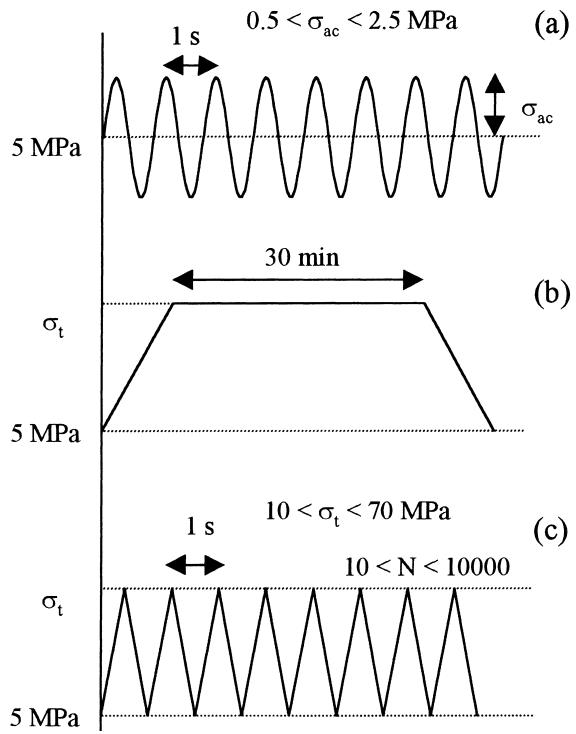
The longitudinal piezoelectric coefficient, , was measured by the direct measurement of the piezoelectric charge generated during the application of an uniaxial stress sine wave. specimens poled along the 10 mm direction were prepared for the two compositions. Measurements were performed in a servohydraulic test machine (Instron 8500), to which a charge to voltage converter (105 nC V ) had been incorporated. This measured the electric charge generated by the application of stress. Stress sine waves of 0.5, 1, 1.5, 2 and 2.5 MPa amplitude, , and of 1 Hz frequency were applied to the sample, which had been pre-loaded with a compressive stress of 5 MPa (see Fig. 1(a)). The piezoelectric coefficient was evaluated as the ratio between the charge generated and the force applied as a function of . The results of vs. were fitted to the expression (Eq. (1)):
where is the intrinsic (without domain wall contributions) piezoelectric coefficient and a measurement of piezoelectric non-linearities related to domain wall contributions.
The coefficient was measured before and after compressive loading along the poling direction for stresses ranging from 10 to 70 MPa. Two different loading profiles were applied:
line chart
| Subplot | Condition | Timeframe |
|---|---|---|
| (a) | 0.5 < σ_ac < 2.5 MPa | Wavy waveform with 1 s and σ_ac label |
| (b) | 30 min | T-shaped waveform with σ_t label |
| (c) | 10 < σ_t < 70 MPa | Linear waveform with σ_t label |
| (c) | 10 < N < 10000 | Linear waveform with σ_t label |
| (c) | 5 MPa | Wavy waveform with 5 MPa label |
Fig. 1. Stress profiles: (a) for the measurement; (b) for degradation in static loading; and (c) for degradation in cyclic loading.
- From 5 MPa to the loading stress, , at 4 MPa min , 30 min at , and back to 5 MPa at -4 MPa min — static loading [see Fig. 1(b)].
- A train of triangular pulses from 5 MPa to with a 1 Hz frequency and increasing (from 10 to 10,000) number of pulses — cyclic loading [see Fig. 1(c)].
The coefficient for the PZT-5H ceramics was also measured before mechanical loading by the resonance technique. mm bars poled along the 10 mm direction were prepared for this measurement. These measurements are performed at high frequencies (the resonance frequencies are typically tens of kHz) compared to the 1 Hz used for the measurements with the test machine.
3. Results and discussion
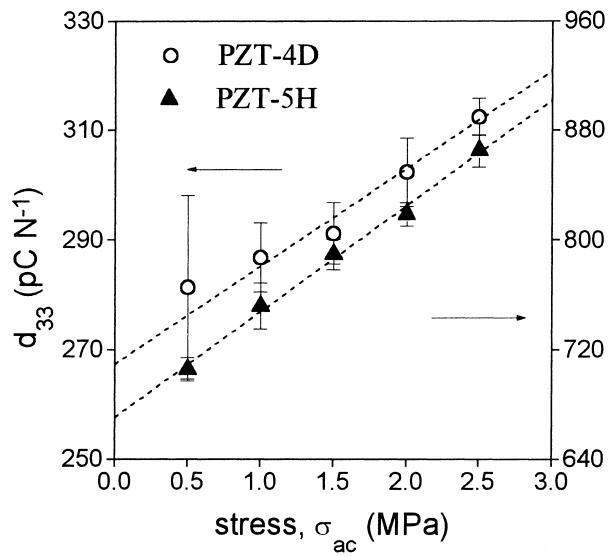
An example of the results of vs. and of their fit to Eq. (1) is given in Fig. 2 for the two compositions. The obtained piezoelectric parameters: and at 1 Hz for the two type of ceramics, and at 127 kHz for the PZT-5H ceramics (from the resonance method), after poling, prior to degradation testing, are given in Table 1. is given because the ratio gives a more representative measure of the level of piezoelectric nonlinearity relative to their values. The level of Sr substituting for Pb in the A site of the perovskite was higher for the PZT-5H material than for the PZT-4D, which gives the former composition a lower Curie temperature, and thus, a higher intrinsic coefficient. The ratio was also higher for the PZT-5H composition as a consequence of its softer character, because of a higher mobility of the ferroelastic domain walls. There is good agreement between the provided by the resonance technique and .
scatterplot
| stress, σ_ac (MPa) | PZT-4D d_33 (pC N⁻¹) | PZT-5H d_33 (pC N⁻¹) |
|---|---|---|
| 0.5 | 280 | 265 |
| 1.0 | 290 | 275 |
| 1.5 | 295 | 285 |
| 2.0 | 305 | 295 |
| 2.5 | 310 | 305 |
Fig. 2. vs. after poling for the two compositions.
Table 1 Piezoelectric parameters of the piezoceramics after poling prior to mechanical loading
| at 1 Hz ( C N) | at 1 Hz ( m N) | at 127 kHz ( C N) | |
|---|---|---|---|
| PZT-4D | 246 27 | 0.08 0.05 | – |
| PZT-5H | 677 18 | 0.11 0.03 | 689 15 |
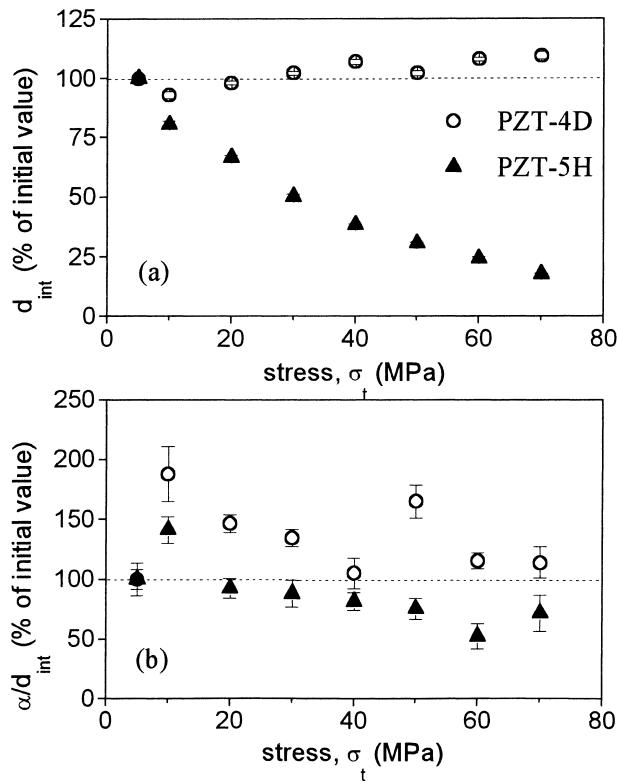
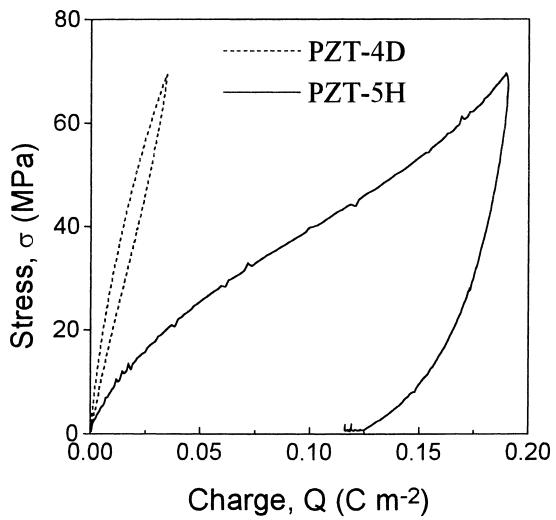
The changes of both and after static loading at increasing stress, expressed as % of the initial values (see Table 1), are shown in Fig. 3. We were aware that depolarisation under static loading does not occur instantaneously but can have a time dependence, which is a consequence of the slow movement of the ferroelastic domain walls under the stress, which manifests itself as mechanical creep. Our system allowed us to monitor the charge transient associated with this creep under static loading, and it was found to essentially arrest ( ) after 10 to 20 min. 30 min was then chosen as a sufficient time to have exhausted this process. The intrinsic coefficient for the PZT-4D piezoceramics was hardly affected by static compressive loading in the stress range investigated (see Fig. 3(a)), indicating the good resistance of this composition against stress induced depolarisation. In comparison, the intrinsic coefficient for the PZT-5H piezoceramics showed a strong degradation. This degradation was fully reversible by repoling, indicating that it was caused by stress induced depolarisation. The coefficient dropped to 50% of its initial value after loading at 30 MPa, and dropped to 25% after loading at 70 MPa. The occurrence of depolarisation for the PZT-5H material and lack of it for the PZT-4D, was confirmed by measuring the electrical charge generated during the application of a compression loop to 70 MPa. The results are shown in Fig. 4. Note that all the charge generated during loading for the PZT-4D ceramic was fully reversed during unloading, but it was not for the PZT-5H sample. for the PZT-4D ceramics increased to a of its initial value after loading, but a systematic trend with the loading stress could not be stated. This increase in the ferroelastic domain wall mobility might be related to a deageing effect. In acceptor doped piezoceramics (hard ceramics), the ferroelastic domain wall mobility is known to be limited by the presence of dopant-oxygen vacancy complexes, which have a dipolar moment that aligns with the spontaneous polarisation within a domain. The deageing would consist of the partial disalignment of the complexes induced by the stress. for the PZT-5H is hardly affected. This indicates that there is not a significant change in the environment of the domain walls after applying the stress.
scatterplot
| stress, σ (MPa) | PZT-4D d_int (% of initial value) | PZT-5H d_int (% of initial value) | PZT-4D α/d_int (% of initial value) | PZT-5H α/d_int (% of initial value) |
|---|---|---|---|---|
| 0 | 100 | 100 | 100 | 100 |
| 10 | 95 | 80 | 190 | 140 |
| 20 | 98 | 68 | 145 | 95 |
| 30 | 102 | 52 | 135 | 90 |
| 40 | 105 | 40 | 105 | 85 |
| 50 | 102 | 32 | 165 | 75 |
| 60 | 108 | 25 | 115 | 50 |
| 70 | 110 | 20 | 110 | 70 |
Fig. 3. Change in the piezoelectric parameters after static loading as a function of the applied stress: (a) , and (b) .
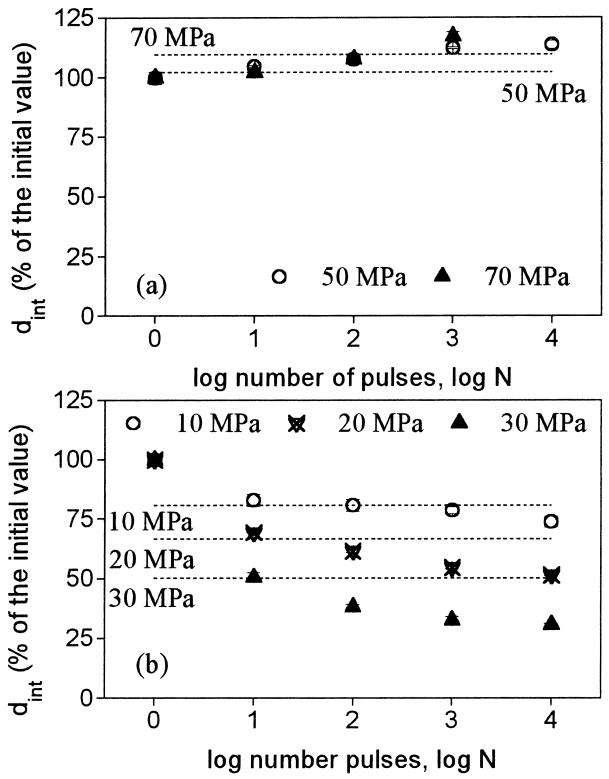
The changes of after cyclic loading at increasing number of pulses, N, expressed as % of the initial values (see Table 1), are shown in Fig. 5 for different stress values, . The changes were fully reversible by repoling. The levels of degradation in static loading are included in the figure as dotted lines for comparison. The intrinsic coefficient for the PZT-4D piezoceramics was not significantly affected by cyclic compressive loading. The point corresponding to 10000 pulses at 70 MPa is missing because the sample fractured along the poling direction during cycling. The intrinsic coefficient for the PZT-5H piezoceramics showed a significant additional degradation in cyclic loading compared to a single static loading. This degradation was already higher after 1800 pulses than that achieved after 30 min under static loading at the maximum cyclic stress, and continued to increase with further cycling. Recall that depolarisation in static loading was exhausted after 30 min.
line chart
| Charge, Q (C m⁻²) | PZT-4D Stress, σ (MPa) | PZT-5H Stress, σ (MPa) |
|---|---|---|
| 0.00 | 0 | 0 |
| 0.05 | ~68 | ~20 |
| 0.10 | ~70 | ~35 |
| 0.15 | ~70 | ~50 |
| 0.20 | ~70 | ~70 |
Fig. 4. Electrical charge-stress loops to 70 MPa for the two ceramics (rate: 58 MPa min ).
scatterplot
| log number pulses, log N | d_int (% of the initial value) - 50 MPa | d_int (% of the initial value) - 70 MPa | d_int (% of the initial value) - 10 MPa | d_int (% of the initial value) - 20 MPa | d_int (% of the initial value) - 30 MPa |
|---|---|---|---|---|---|
| 0 | 100 | 100 | 80 | 70 | 50 |
| 1 | 105 | 105 | 80 | 70 | 50 |
| 2 | 110 | 110 | 80 | 65 | 40 |
| 3 | 115 | 115 | 80 | 55 | 35 |
| 4 | 115 | 115 | 75 | 50 | 30 |
Fig. 5. Change in after cyclic loading as a function of the number of pulses for different applied stress: (a) PZT-4D; and (b) PZT-5H. The dashed lines correspond to the values for static loading.
for the PZT-4D ceramics decreased after cyclic loading, contrary to what it did in static loading. This seems a surprising result for which we can offer no explanation. More research is in progress to investigate this topic. for the PZT-5H ceramics was not significantly affected by cyclic loading consistent with the static loading results.
4. Conclusions
The intrinsic piezoelectric coefficient, , for PZT-4D hard piezoceramics was highly resistant to degradation under static and cyclic compressive loading along the poling direction in the range 10–70 MPa, indicating the absence of stress induced depolarisation. The piezoelectric non-linearities slightly increased after static loading. This increase of the ferroelastic domain wall mobility was most probably linked to a deageing effect. The for PZT-5H soft piezoceamics strongly degraded after compressive loading, to 50% of its value after poling after static loading at 30 MPa, and to 25% after loading at 70 MPa. The level of non-linearity is not affected by stress for the soft ceramic. The degradation in , and so in , is significantly higher in cyclic loading than in static loading for a given stress. Therefore, the thresholds for depolarisation evaluated by static loading are meaningless for applications involving cyclic stresses, and that a specific characterisation, as done here, is necessary to predict long-term behaviour.
Acknowledgements
This work was funded through a Marie Curie Fellowship within the Training and Mobility of Researchers Programme of the European Commission (Contract No. ERBFMBICT983359). The support of an EPSRC grant (GR/L90361) is also acknowledged.
References
- Uchino, K., Materials issues in design and performance of piezoelectric actuators: an overview. Acta Mater., 1998, 46(11), 3745–3753.
- Chang, S. H. and Wang, H. C., A high speed impact actuator using multilayer piezoelectric ceramics. Sensors and Actuators A, 1990, 24, 239–244.
- Cao, H. and Evans, A. G., Nonlinear deformation of ferroelectric ceramics. J. Am. Ceram. Soc., 1993, 76(4), 890–896.
- Zhang, Q. M., Zhao, J., Uchino, K. and Zheng, J., Change of the weak-field properties of piezoceramics with compressive uniaxial stresses and its links to the effect of dopants on the stability of the polarizations in the material. J. Mater. Res., 1997, 12(1), 226–235.
- Damjanovic, D. and Demartin, M., The Rayleigh law in piezoelectric ceramics. J. Phys. D: Appl. Phys., 1996, 29, 2057–2060.
- Morgan Matroc Limited — Transducer Products Division. Piezoelectric Ceramics Data Book for Designers, p. 10.
- Zhang, Q. M., Wang, H., Kim, N. and Cross, L. E., Direct evaluation of domain wall and intrinsic contributions to the dielectric and piezoelectric response and their temperature dependence on lead zirconate-titanate ceramics. J. Appl. Phys., 1994, 75(1), 454–459.
- Damjanovic, D., Logarithmic frequency dependence of the piezoelectric effect due to pinning of ferroelectric-ferroelastic domain walls. Phys. Rev. B, 1997, 55(2), R649–R652.
- ANSI/IEEE Standard 176-1987 on Piezoelectricity.
- Fett, T. and Thun, G., Determination of room-temperature tensile creep of PZT. J. Mater. Sci. Lett., 1998, 17, 1929–1931.
- Robels, U. and Arlt, G., Domain wall clamping by orientation of defects. J. Appl. Phys., 1993, 73(7), 3454–3460.